
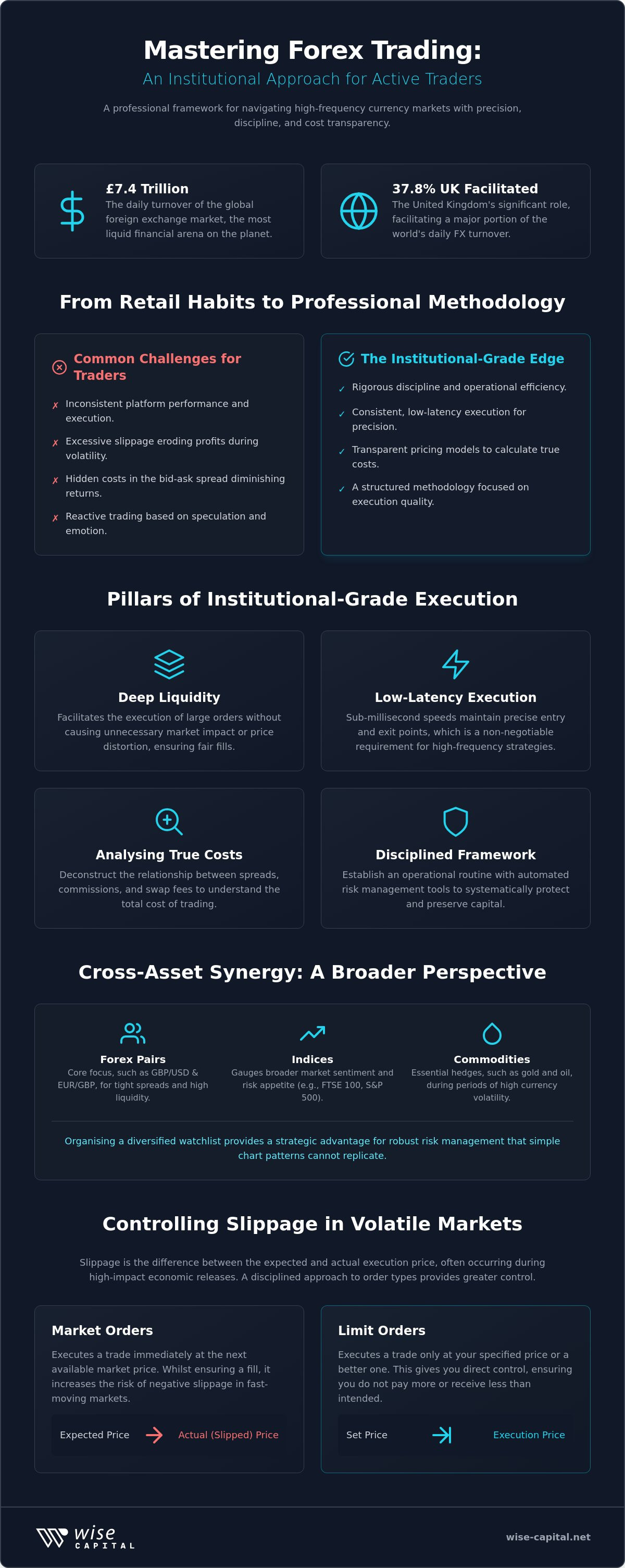
In a global market where the United Kingdom facilitates 37.8% of the £7.4 trillion daily turnover, the margin between a successful strategy and a significant loss often resides in the sub-millisecond mechanics of execution. You likely recognise that inconsistent platform performance and excessive slippage during peak liquidity are more than just minor inconveniences; they are direct threats to your capital. For those engaging in forex trading for active traders, the focus must shift from speculative guesswork to the rigorous discipline of institutional-grade operational efficiency.
We understand that hidden costs in the bid-ask spread can quietly erode your returns. This guide provides a professional framework for mastering high-frequency currency markets whilst leveraging transparent pricing models. You will learn how to secure consistent execution speeds and utilise advanced risk management tools to maintain a steady hand. We will examine the transition from standard retail habits to a structured, professional-grade methodology that prioritises execution quality and cost transparency above all else. By focusing on the mechanics of the service and the clarity of the process, you can navigate volatile sessions with informed intent and controlled risk.
Key Takeaways
- Understand how deep liquidity facilitates the execution of large orders without triggering unnecessary market impact.
- Identify the core components of institutional-grade execution and the role of low latency in maintaining precise entry and exit points.
- Learn to calculate the true cost of forex trading for active traders by deconstructing the relationship between spreads, commissions, and swap fees.
- Establish a disciplined operational framework using pre-market routines and automated risk management tools to preserve capital.
- Recognise the strategic benefits of leveraging a specialist brokerage for reliable, professional-grade market access.
Table of Contents
- Navigating the Complexities of Forex Trading for Active Traders
- The Role of Institutional-Grade Execution in Strategic Trading
- Analysing the True Cost of Trading: Spreads, Commissions, and Slippage
- Methodologies for Maintaining Discipline in High-Frequency Markets
- Partnering with Wise Capital for Professional Market Access
Navigating the Complexities of Forex Trading for Active Traders
The foreign exchange market represents the most liquid financial arena on the planet, with daily turnover exceeding £7.4 trillion. Within this vast ecosystem, active trading refers to the high-frequency execution of positions, often held for short durations to capitalise on intraday price movements. Effective forex trading for active traders requires more than just a basic understanding of price action; it demands an environment where high liquidity ensures that even substantial orders are filled without significant market impact or price distortion.
Professional participants typically focus their efforts on major currency pairs, such as GBP/USD and EUR/GBP. These pairs offer the tightest spreads and the highest depth of market, which is essential for maintaining profitability over hundreds of trades. Shifting from retail-level speculation to a professional-grade methodology involves treating trading as a business of execution rather than a series of guesses. This transition focuses on the mechanics of the trade, prioritising low latency and transparent pricing over the emotional highs of a winning streak.
The Active Trader Profile: Discipline and Strategy
Successful high-volume participants share a common trait: they operate with clinical precision. They don't react to every minor tick in price. Instead, they follow a meticulously structured trading plan that remains fixed even amongst significant market noise. Emotional composure serves as the bedrock of this approach. It's the ability to execute a stop-loss without hesitation or wait for a specific setup during periods of low volatility that separates the professional from the amateur. For those committed to forex trading for active traders, discipline is the primary tool for capital preservation.
Cross-Asset Synergy: Forex, Indices, and Commodities
Active traders rarely view the currency market in isolation. They use indices, such as the FTSE 100 or S&P 500, to gauge broader market sentiment and risk appetite. When global equities face pressure, currency flows often shift into safe-haven assets. Commodities also play a vital role. Gold and oil frequently serve as essential hedges during periods of intense currency volatility. By organising a diversified watchlist that includes these assets, you can identify correlations that offer a clearer picture of market direction. This cross-asset perspective provides a strategic advantage that simple chart patterns cannot replicate, allowing for a more robust approach to risk management.
The Role of Institutional-Grade Execution in Strategic Trading
Institutional-grade execution is more than a marketing term; it describes a structural framework where retail participants access the same execution quality as major financial institutions. For those investigating What Is Forex Trading?, it's clear that market dynamics depend heavily on how quickly an order reaches the core of the exchange. Institutional-grade execution acts as the bridge between retail traders and top-tier liquidity. This environment ensures that your orders are treated with the same priority as those from global banks, minimising the gap between your intended price and the actual fill.
For forex trading for active traders, low latency is a requirement rather than a luxury. When execution speeds are measured in milliseconds, even a minor delay can result in a price shift that negates a strategy's edge. This precision relies on a robust technology stack, often involving servers co-located near liquidity hubs in London or New York. Transparent execution models ensure that orders aren't held in a "waiting room" by the broker. This transparency mitigates the risk of artificial broker-side delays that could compromise your entry or exit precision.
Minimising Slippage During High Volatility
Slippage occurs when a lack of liquidity at a specific price point forces an order to be filled at the next available level. This is particularly common during high-impact UK economic releases or central bank announcements. Active traders often use limit orders instead of market orders to exert control over their entry price. By setting a maximum price for a "buy" or a minimum for a "sell", you ensure that a trade only executes on your specific terms. Wise Capital’s focus on transparent execution helps protect trader margins by providing a direct path to market-driven pricing without hidden markups.
Liquidity Pools and Order Filling
Deep liquidity serves as the foundation of a stable trading environment. It allows for the filling of large positions at the best possible price without causing significant volatility. A broker that aggregates multiple liquidity providers ensures competitive bid-ask spreads even during quieter trading sessions. This structural depth provides the resilience needed to execute complex forex trading for active traders with confidence. If you're looking for a platform that prioritises these operational standards, you can explore professional market access tailored for high-volume participants.
Analysing the True Cost of Trading: Spreads, Commissions, and Slippage
Profitability in forex trading for active traders isn't solely determined by market direction. It's often defined by the friction costs associated with every execution. A professional trader views the total cost as a combination of the bid-ask spread, commissions, swap fees, and slippage. Whilst many retail platforms promote "commission-free" trading, this often conceals wider spreads that increase the total expense. For instance, a £5.50 commission on a standard lot is equivalent to roughly 0.7 pips. If a spread-only account features a 1.5 pip markup, the trader is paying significantly more per transaction than they would on a raw spread account with a fixed commission.
The long-term impact of even a 0.1 pip difference is substantial for high-frequency participants. Over the course of 1,000 standard lots, that minor variance represents a significant sum that either stays in your account or is lost to the broker. Adhering to the principles of transparency, such as those discussed in the NFA Forex Regulatory Guide, helps traders understand the necessity of clear fee structures. Managing these expenses is a core component of forex trading for active traders who seek to maintain a sustainable edge over the competition.
The Bid-Ask Spread: Beyond the Surface
Spreads are rarely static. Variable spreads fluctuate based on liquidity and volatility, typically tightening during the London and New York session overlap. Active traders must remain vigilant against "artificial" spread widening, which can occur during low-liquidity periods or just before major news events. Recognising the relationship between market volatility and spread competitiveness allows you to time your entries more effectively. A transparent broker provides consistent access to raw spreads, ensuring that you aren't penalised during sessions where market depth is naturally thinner.
Managing Overnight Financing Costs
Position management extends beyond the initial entry. When holding trades past the 10:00 PM UK cut-off, you encounter swap rates, which represent the interest rate differential between the two currencies in a pair. These costs can accumulate quickly on multi-day positions. Professional participants often use strategies to minimise these financing charges, such as closing positions before the rollover or selecting pairs with favourable interest carry. Transparent fee disclosures are vital for this level of planning. They allow you to calculate the precise cost of maintaining a position, ensuring your risk-to-reward ratios remain accurate over time.
Methodologies for Maintaining Discipline in High-Frequency Markets
Discipline provides the operational structure necessary to survive the inherent volatility of high-frequency environments. For those engaged in forex trading for active traders, success isn't merely about identifying patterns; it's about the consistent application of a refined methodology. A study by a major regulator in 2024 found that over 91% of individual derivatives traders incurred losses, a statistic that underscores the high-risk nature of leveraged markets. Professional participants mitigate this risk by establishing a rigid pre-market routine that organises strategic objectives before the London session begins.
Automated risk management serves as a critical safeguard for your capital. By utilising tools that automatically calculate position sizing and enforce maximum drawdown limits, you remove the emotional burden of decision-making during rapid price shifts. Maintaining a detailed trading journal allows you to analyse your behaviour and refine your execution over time. This process helps identify whether losses resulted from a flawed strategy or a failure in execution discipline. If you're ready to implement these professional standards, you can access advanced market research and analysis to support your strategic workflow.
Integrating Market Research into Your Workflow
Effective research requires distinguishing between high-impact macro data and mere market noise. Active traders don't react to every headline. Instead, they use professional-grade research to anticipate volatility and validate technical signals. Sentiment indicators often act as a contrarian or confirmation tool, providing insight into how the broader market is positioned. This structured approach ensures that every trade is backed by a logical premise rather than a reactive impulse.
A 5-Step Execution Checklist for Active Traders
A standardised checklist ensures that every position meets your rigorous criteria for entry and risk management. This process creates a repeatable framework for success.
- Step 1: Confirm technical alignment across multiple timeframes to ensure the intraday trend matches the broader market direction.
- Step 2: Check the economic calendar for immediate volatility risks, such as UK employment data or central bank speeches.
- Step 3: Calculate the precise position size based on strict risk-per-trade rules, ensuring no single trade compromises your account balance.
- Step 4: Set hard stop-losses and take-profit levels prior to entry to prevent emotional interference once the trade is live.
- Step 5: Review execution quality post-trade to identify slippage patterns and assess whether the entry price aligned with your expectations.
By following this methodical approach, you transform forex trading for active traders from a speculative activity into a disciplined business process. This focus on operational efficiency and methodology is what allows serious participants to maintain control in the face of unpredictable market movements.
Partnering with Wise Capital for Professional Market Access
Selecting a brokerage is a strategic operational decision that directly impacts your capital and execution quality. Wise Capital provides a stable trading environment backed by over 15 years of industry experience. This longevity ensures that our infrastructure is tested, resilient, and capable of supporting high-volume strategies. For those involved in forex trading for active traders, being partnered with a London-based brokerage offers a distinct geographical and regulatory advantage. London remains the global centre for currency exchange, and our presence here provides direct access to the world's deepest liquidity pools.
Active traders require more than just a basic interface. You need platforms designed for speed and tactical precision, capable of handling rapid execution without latency issues. Our suite of tools allows for the swift entry and exit of positions, which is vital when market conditions shift in seconds. Beyond the technology, we provide personalised support tailored to the specific needs of serious participants. You won't deal with generic scripts; instead, you'll communicate with professionals who understand the mechanics of high-frequency markets and the necessity of uptime.
Transparent Execution as a Core Principle
Our execution model prioritises the interests of the trader by ensuring every order is filled at the best available market price. We avoid the high-energy, speculative hype that often permeates the retail industry. Instead, we opt for a grounded approach that focuses on the practicalities of execution and capital protection. This business-like efficiency provides the structured environment you need to trade with confidence. Wise Capital remains dedicated to providing a disciplined and transparent environment for professional market access.
Next Steps for the Serious Trader
Transitioning your portfolio to a more professional environment is a logical step for those who have outgrown standard retail offerings. By moving to a platform that values methodology and operational efficiency, you can focus on refining your strategy rather than fighting your infrastructure. We provide the tools and market research necessary to validate your technical signals and manage risk with precision. You can access Wise Capital’s professional trading environment today to begin optimising your execution.
Whether you're scaling your current strategy or seeking more competitive spreads, our environment is built to support your growth. Our commitment to transparency and discipline ensures that you have a reliable partner for your long-term trading objectives. This professional framework allows you to approach the market with the quiet confidence of a seasoned expert, backed by the tools required for success in forex trading for active traders.
Elevating Your Execution Strategy
Professional trading requires a shift from simple market predictions to a comprehensive focus on operational precision. You've seen how institutional-grade execution and deep liquidity pools are essential for minimising slippage during volatile London sessions. By deconstructing the true cost of every trade and prioritising transparent commission models, you can protect your margins against the hidden erosion of wide spreads. Success in forex trading for active traders depends on this marriage of technical strategy and disciplined execution.
Wise Capital provides the stable environment necessary for serious participants to scale their operations. With over 15 years of brokerage experience and a focus on London-based professional execution, we offer the tools and transparent bid-ask spreads you need to maintain control. It's time to move beyond retail-level limitations and adopt a methodology built for tactical precision. We provide the infrastructure that allows you to act with informed intent and steady confidence.
Open a professional trading account with Wise Capital and begin executing with the clarity your strategy deserves. We look forward to supporting your transition to a more disciplined and efficient trading workflow.
Frequently Asked Questions
What is the best forex trading strategy for active traders?
There's no single strategy that guarantees success, but many prioritising forex trading for active traders utilise scalping or intraday trend-following methodologies. These approaches focus on capturing small price movements across high-volume sessions. Success requires a combination of technical indicators, such as volume-weighted average price (VWAP), and a strict adherence to pre-defined exit rules to manage risk effectively.
How much capital do I need for active forex trading in the UK?
UK capital requirements depend on your chosen leverage and risk management strategy. Whilst some platforms allow entry with smaller amounts, professional participants often start with enough capital to ensure that a single trade doesn't represent more than 1% to 2% of their total balance. This buffer protects against the natural variance found in high-frequency markets and ensures you can meet margin requirements.
Can I trade indices and commodities on the same platform as forex?
Professional platforms generally provide access to forex, indices, and commodities from a single interface. This integration allows you to monitor correlations, such as how the FTSE 100 might influence GBP strength, without switching applications. It's a vital feature for those who use cross-asset analysis to validate their primary currency signals and diversify their tactical opportunities.
What is the difference between a retail and an institutional-grade broker?
The primary difference lies in execution quality and transparency. Institutional-grade brokers offer direct access to liquidity providers and lower latency than standard retail models. This structure minimises broker-side interference and ensures that you receive the most competitive market prices available at the time of execution, which is essential for maintaining a high-frequency edge.
How does leverage work for active traders in a regulated environment?
In the UK, the Financial Conduct Authority (FCA) regulates leverage to protect participants from excessive losses. For major currency pairs, leverage is typically capped at 30:1. This means you can control a position worth £30,000 with a £1,000 margin. It's a tool for capital efficiency that requires disciplined risk management to prevent rapid account depletion.
What are the main risks associated with high-frequency forex trading?
The main risks involve market volatility and operational latency. Rapid price shifts during news events can lead to slippage, whilst technical delays can result in poor entry prices. Managing these risks requires a combination of robust technology and the emotional discipline to stick to a pre-defined trading plan even when the market moves against your position.
How can I minimise the impact of slippage on my trades?
You can minimise slippage by using limit orders instead of market orders to control your entry price. Trading during the London and New York session overlap also helps, as this is when global liquidity is at its peak. Choosing a broker with co-located servers near major financial centres like London further reduces the risk of execution delays.
Why are spreads more important for active traders than for long-term investors?
Spreads represent a direct transaction cost that compounds with every trade. For forex trading for active traders, who may execute dozens of positions daily, even a minor variance in the spread can significantly impact net profitability over a month. Unlike long-term investors, active participants must prioritise tight, transparent spreads to ensure their strategy remains viable after all costs are deducted.