
Most traders treat the daily rollover as an unavoidable tax on their capital; the most disciplined market participants view it as a primary source of strategic edge. You've likely felt the frustration of seeing a profitable position eroded by unexpected financing charges or struggled to reconcile why your account balance shifts late in the evening. These costs aren't hidden, but they're often misunderstood. Mastering overnight swap rates forex is essential for any serious trader who wants to maintain a structured and profitable portfolio in 2026.
It's understandable to feel cautious about holding positions when interest rate differentials appear volatile. This guide promises to equip you with a professional-grade understanding of how these rates are calculated and how to integrate them into a methodical strategy. We'll examine the mechanics of current central bank policies, such as the Bank of England's 3.75% base rate, and identify currency pairs with high carry potential. You'll also learn how to organise your trading schedule to minimise fees and avoid the impact of triple-swap Wednesdays, ensuring your operations remain efficient and transparent.
Key Takeaways
- Understand how the daily rollover process functions as a simultaneous closing and reopening of positions to manage global interest rate differentials.
- Master the precise mechanics of how overnight swap rates forex are determined using pip values and interest rate spreads to predict daily financing costs accurately.
- Identify opportunities for positive carry by selecting currency pairs that earn interest; account for the difference between swap bid and offer prices to maintain margin.
- Optimise your trading schedule to account for the "Triple Swap Wednesday" phenomenon, ensuring weekend interest charges don't impact your net profitability unexpectedly.
- Leverage institutional-grade methodology and transparent pricing structures to manage long-term portfolio costs with professional discipline.
Understanding Overnight Swap Rates and the Rollover Process
In the institutional currency markets, every position held past the end of the trading day is subject to a financing adjustment. This adjustment, known as a swap, represents the interest rate differential between the two currencies within a pair. Because forex trading involves the simultaneous purchase of one currency and the sale of another, you are essentially lending one asset whilst borrowing the other. The cost or credit resulting from this exchange is reflected in the swap rate applied to your account balance. This ensures that the financial reality of holding a currency is accurately mirrored in your trading account.
The process of extending the settlement date of an open position is called a rollover. In the spot market, trades typically settle two business days after execution. To avoid the physical delivery of currency, brokers simultaneously close the existing position and reopen it for the next available value date. This technical manoeuvre ensures that traders can maintain long-term exposure without the logistical burden of settlement. The specific rate used for this extension is determined by the "Tom-Next" (Tomorrow-Next Day) market, which tracks the cost of carrying a position for twenty-four hours.
The Daily Market Close and Account Adjustments
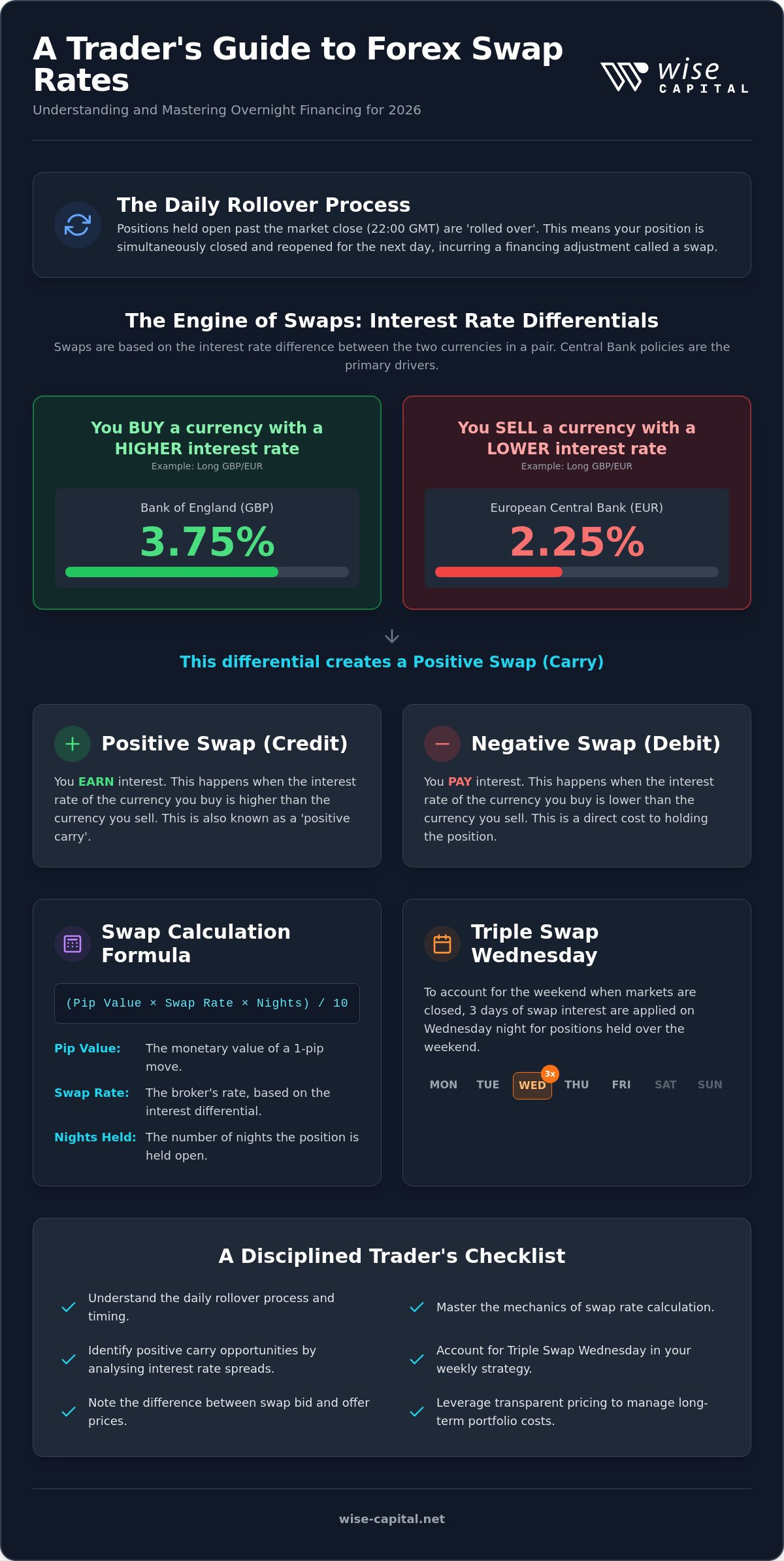
Most brokers synchronise their rollover process with the New York market close, which occurs at 22:00 GMT. Any position remaining open at this precise cut-off point is considered an "overnight" hold and will incur or earn a swap fee. Traders who focus on intraday behaviour typically close their positions before this time to avoid financing costs. Conversely, swing traders must factor these daily adjustments into their total cost of carry. It's a binary threshold; holding a trade until 22:01 GMT triggers the adjustment, whilst closing at 21:59 GMT does not.
Why Interest Rate Differentials Matter
Central Bank policies are the primary drivers of overnight swap rates forex. When you hold a long position in a currency with a high interest rate against one with a lower rate, you typically earn a positive swap. For instance, with the Bank of England base rate at 3.75% and the ECB deposit facility at 2.25%, a long GBP/EUR position reflects this spread. The interest rate differential is the variance between the lending rate of the base currency and the borrowing rate of the quote currency. These rates are not static; they fluctuate based on liquidity, market volatility, and shifts in monetary policy from institutions like the Federal Reserve or the Bank of Japan.
The Mechanics of Calculation: How Swap Rates are Determined
Calculating overnight swap rates forex requires a precise formula to ensure account transparency. The standard calculation used by most institutional platforms is: (Pip Value × Swap Rate × Number of Nights) / 10. These rates are typically denominated in pips of the quote currency. For example, if you are trading GBP/EUR, the swap value is calculated in Euros before being converted back to your base account currency, such as British Pounds (£). Disciplined traders always verify these figures against their broker’s published rates to ensure no unexpected admin markups are eroding their margin.
The difference between a swap bid and a swap offer is critical. Just as there is a spread on the price of a currency pair, there is a spread on the financing rate. You'll often find that the rate for a long position differs significantly from the short position. This reflects the underlying central bank use of foreign exchange swaps and how commercial banks manage liquidity. A transparent broker will clearly disclose their administrative fees, allowing you to see the raw market rate versus the final charge applied to your platform.
Factors Influencing Daily Swap Fluctuations
Swap rates are highly sensitive to market liquidity and volatility. During periods of economic uncertainty, the Tom-Next market can experience sharp price swings, directly impacting the daily rollover cost. Upcoming interest rate decisions from the Bank of England or the Federal Reserve often cause swaps to shift rapidly as markets price in new expectations. Because these rates aren't fixed, it's vital to monitor your platform's market research and analysis to stay ahead of potential adjustments.
Calculating the Real-World Impact on Your Margin
Consider a hypothetical trade where you hold 1 lot of EUR/GBP. If the long swap rate is -0.5 pips and the pip value is £10, a single night's hold costs £0.50. Whilst this seems negligible, holding ten lots over a week results in a £35.00 charge. Leverage magnifies this impact; as your position size increases relative to your balance, financing fees become a larger percentage of your realised profit or loss. To maintain control, you should organise a structured trading log that tracks these costs alongside your entry and exit points.
Positive vs Negative Swaps: Strategic Analysis for Traders
Traders often view the daily rollover as a simple cost of doing business, yet it can also serve as a professional revenue stream. A positive swap occurs when you hold a long position in a currency with a higher interest rate against one with a lower rate. This results in a daily credit to your account. Conversely, a negative swap is a debit, representing the cost of borrowing a high-yield currency to fund a low-yield purchase. Understanding the mechanics of FX swaps is vital because these rates aren't always symmetrical. You might occasionally see negative overnight swap rates forex on both sides of a trade. This happens when the interest rate differential is narrow and the broker’s administrative markup or market spread exceeds the potential credit.
Whilst earning interest is beneficial, a positive swap shouldn't be the primary justification for a trade. Disciplined participants prioritise technical and fundamental alignment first. A credit of a few pips is irrelevant if the underlying pair moves hundreds of pips against your position. However, when a strong technical trend aligns with a positive interest rate differential, it creates a powerful tailwind for long-term profitability. This synergy allows you to be paid whilst you wait for your price target to be hit.
The Carry Trade: Capitalising on Interest Differentials
The carry trade remains a favourite methodology amongst macro-economic investors in 2026. This strategy involves selling a low-yielding "funding currency" to buy a higher-yielding asset. With the Bank of Japan maintaining a benchmark rate of 1.00% whilst the Bank of England sits at 3.75%, pairs like GBP/JPY often attract carry traders. Other common funding currencies include the Euro, which currently has a deposit facility rate of 2.25%. The risk lies in volatility; if the funding currency spikes or the high-yield currency crashes, the capital loss can quickly dwarf months of interest gains. Successful execution requires a stable global environment and a clear exit plan.
Long-Term Position Management and Swap Erosion
Negative swaps can quietly erode the net profit of a winning trade if held for weeks or months. To maintain a structured approach, you must evaluate whether the expected capital gain justifies the carry cost. Before committing to a long-term position, consider this checklist:
- Does the technical trend offer enough "headroom" to absorb the projected swap costs?
- Is the interest rate gap between the two central banks expected to widen or narrow?
- Could the trade be executed in a different pair with similar correlation but better swap terms?
Managing Overnight Costs: Triple Swap Days and Timing
One of the most critical operational details for a disciplined trader to master is the "Triple Swap Wednesday" phenomenon. This isn't an arbitrary fee or a broker penalty; it's a direct result of how the global banking system handles settlement. Whilst the forex market operates 24 hours a day, five days a week, the underlying financial institutions require two business days to settle transactions. This standard T+2 settlement cycle dictates when overnight swap rates forex are applied to your account. Understanding this rhythm allows you to organise your trades with precision, ensuring that financing costs don't catch you off guard mid-week.
For most currency pairs, holding a position past 22:00 GMT on a Wednesday triggers a three-day interest charge. This accounts for the upcoming Saturday and Sunday, during which the markets are closed but interest still accrues on the underlying borrowed capital. It's also vital to recognise that this schedule varies across different asset classes. Whilst forex usually follows the Wednesday rule, many indices and commodities apply their triple swap on a Friday. Failing to account for these variations can lead to unexpected margin pressure, especially when trading with higher leverage.
The T+2 Settlement Cycle Explained
Most spot forex trades take two business days to reach final settlement. If you open a position on Monday, it effectively settles on Wednesday. When you hold that position past the Wednesday 22:00 GMT cut-off, the new settlement date moves from Friday to the following Monday. Because banks are unable to settle trades over the weekend, the interest for Saturday and Sunday is brought forward and applied simultaneously with the Friday-to-Monday rollover. You can avoid these charges entirely by closing your positions before the 22:00 GMT threshold.
Holiday Schedules and Adjusted Rollovers
Public holidays in the United Kingdom or the native country of a currency pair can significantly alter the rollover schedule. If a settlement date falls on a bank holiday, the rollover is typically pushed to the next available business day, which may result in more than one day of interest being charged at once. This requires a methodical approach to position management during major global holidays like Christmas or Easter. To maintain full control over your financing costs, you should access Wise Capital’s market research and analysis to stay informed of upcoming holiday schedule adjustments and their impact on your open trades.
Executing Disciplined Strategies with Wise Capital
Wise Capital has operated within the established UK financial landscape for over 15 years, providing a stable platform for serious market participants. This longevity is built on a foundation of transparent execution and a disciplined approach to managing overnight swap rates forex. When you manage complex positions that span multiple days, the reliability of your broker's pricing structure becomes a primary factor in your net profitability. We understand that traders require a steady hand and a structured environment to execute their methodologies without the distraction of ambiguous costs or hidden fees.
A professional trading strategy relies on more than just technical indicators; it requires a deep understanding of the operational environment. Our commitment to clarity ensures that you have the data necessary to make informed decisions about your carry costs. By providing a direct link between market dynamics and account adjustments, we empower you to trade with the quiet confidence of a seasoned professional.
Transparent Execution and Institutional Grade Speeds
We provide the professional-grade tools needed to monitor and forecast overnight swap rates forex with precision. Our platform is designed to eliminate hidden markups, ensuring that the financing rates you see reflect the actual interest rate differentials of the global markets. By integrating our market research and analysis into your daily routine, you can anticipate shifts in central bank policy, such as the Bank of England's 3.75% base rate, before they impact your margin. Having access to a dedicated support team ensures that active traders can resolve technical queries or settlement questions quickly, maintaining the momentum required for institutional-grade execution. This level of responsiveness is essential when navigating the T+2 settlement cycle and the nuances of triple swap Wednesdays.
Getting Started with a Professional Trading Account
Opening a trading account with Wise Capital provides seamless access to a wide array of instruments, from major currency pairs to global indices and commodities. The process is designed for efficiency, reflecting our commitment to business-like support for a professional clientele. For those who wish to refine their approach to managing rollover costs, we offer demo accounts that allow you to practise interest rate arbitrage and carry trade strategies in a risk-free environment. This methodical preparation ensures you are fully equipped to handle the mechanics of financing fees and holiday adjustments once you transition to live market conditions. Experience transparent execution with Wise Capital today.
Optimising Your Long-Term Trading Framework
Mastering the operational nuances of the currency market is what separates speculative participants from disciplined professionals. You now have the framework to evaluate how central bank policies and the T+2 settlement cycle dictate the daily rollover process. By integrating a deep understanding of overnight swap rates forex into your broader methodology, you can transform a routine cost into a strategic component of your portfolio management. Whether you're capitalising on interest rate differentials or tactically timing your exits to avoid triple-swap days, maintaining this level of control is essential for consistent execution in 2026.
Wise Capital provides the structured environment required for this level of precision. With over 15 years of brokerage expertise and a dedicated London-based support team, we prioritise transparency in every aspect of our service. This includes providing clear financing costs and competitive bid-ask spreads that respect your bottom line and your strategy.
Open a professional trading account with Wise Capital today to experience a higher standard of execution. With the right tools and a methodical mindset, you are well-positioned to navigate the global markets with stability and intent.
Frequently Asked Questions
What is an overnight swap rate in forex?
An overnight swap rate is the interest paid or earned for holding a currency position past the daily market close. It represents the differential between the interest rates of the two central banks involved in the pair. If you buy a currency with a higher rate than the one you sell, you typically receive a credit; otherwise, your account is debited to cover the borrowing cost.
Why is my swap fee tripled on a Wednesday?
Swap fees are tripled on Wednesdays to account for the interest accrued over the weekend when banks are closed. Because the forex market operates on a T+2 settlement cycle, a trade held past Wednesday evening effectively settles on the following Monday. This rollover captures the financing costs for Saturday and Sunday in a single transaction to maintain the standard settlement schedule.
Can I earn money from forex swap rates?
You can earn a credit by maintaining positions with a positive interest rate differential, a strategy commonly known as a carry trade. For example, buying a high-yielding currency against a lower-yielding one can result in daily interest payments added to your balance. However, you must ensure that potential capital depreciation in the exchange rate doesn't outweigh these daily interest gains.
Is it possible to trade forex without paying swap fees?
You can avoid overnight swap rates forex by closing all open positions before the 22:00 GMT daily cut-off. Traders who execute intraday strategies never incur these charges because their trades don't roll over to the next value date. Alternatively, some brokers offer specialised swap-free accounts for clients who cannot pay or receive interest due to religious beliefs or specific institutional requirements.
How do interest rate changes impact my open positions?
Central bank policy shifts directly alter the cost of carry for any open trades. If the Bank of England raises the base rate, the swap for long GBP positions typically increases, whilst the cost for short positions becomes more expensive. These adjustments happen as soon as the new rates are priced into the interbank market, affecting the daily rollover value immediately.
What time is the forex rollover in the UK?
The daily rollover in the UK typically occurs at 22:00 GMT, which corresponds to the New York market close. During British Summer Time, this cut-off moves to 23:00 local time. Any trade held one minute past this threshold is considered an overnight position and is subject to the daily financing adjustment based on that day's published rates on the platform.
Are swap rates the same for all forex brokers?
Swap rates are not standardised and vary significantly amongst different brokerage firms. Each provider has unique liquidity arrangements and applies its own administrative markups to the raw interbank rates. Disciplined traders compare these costs across platforms to ensure their long-term strategies remain cost-effective and transparent, as even small differences in overnight swap rates forex impact annual profitability.
How does leverage affect the amount of swap I pay?
Leverage increases the total notional value of your trade, which directly scales the absolute swap amount. Because swap rates are calculated on the full contract size rather than just your deposited margin, a highly leveraged position will incur much larger financing fees. You must factor this into your margin management and risk calculations to avoid unexpected capital erosion during long-term holds.