
Leverage isn't a speculative gamble; it's an institutional-grade tool for capital efficiency that requires a structured environment and transparent execution to be effective. While many traders focus on the potential for amplified returns, the seasoned professional understands that the real value of leveraged forex trading uk lies in the ability to manage liquidity without overcommitting capital. It's natural to feel concerned about the 1:30 margin requirements set by the Financial Conduct Authority (FCA) or the threat of slippage during periods of high volatility. These constraints are designed for protection, yet they can feel restrictive if you don't fully grasp the underlying mechanics.
We'll help you master these complexities by providing a disciplined framework for capital usage. You'll learn the critical distinctions between retail and professional leverage tiers, how to calculate margin requirements with precision, and how to select a broker that prioritises execution clarity. By the end of this guide, you'll have the technical knowledge and risk discipline required to utilise leverage as a strategic asset rather than a source of uncertainty.
Key Takeaways
- Learn how leverage functions as a ratio of your own capital to total position size to enhance your market buying power.
- Master the mechanics of leveraged forex trading uk by distinguishing between initial margin requirements and the maintenance equity needed to keep positions open.
- Transition from speculation to strategy by prioritising position sizing and adjusting your leverage ratios based on market volatility.
- Understand why low-latency execution is vital for preventing slippage and maintaining the integrity of your risk-reward profile.
- Discover how a disciplined trading environment and Wise Capital's dedicated support can help you manage capital efficiency more effectively.
The Fundamentals of Leveraged Forex Trading in the UK
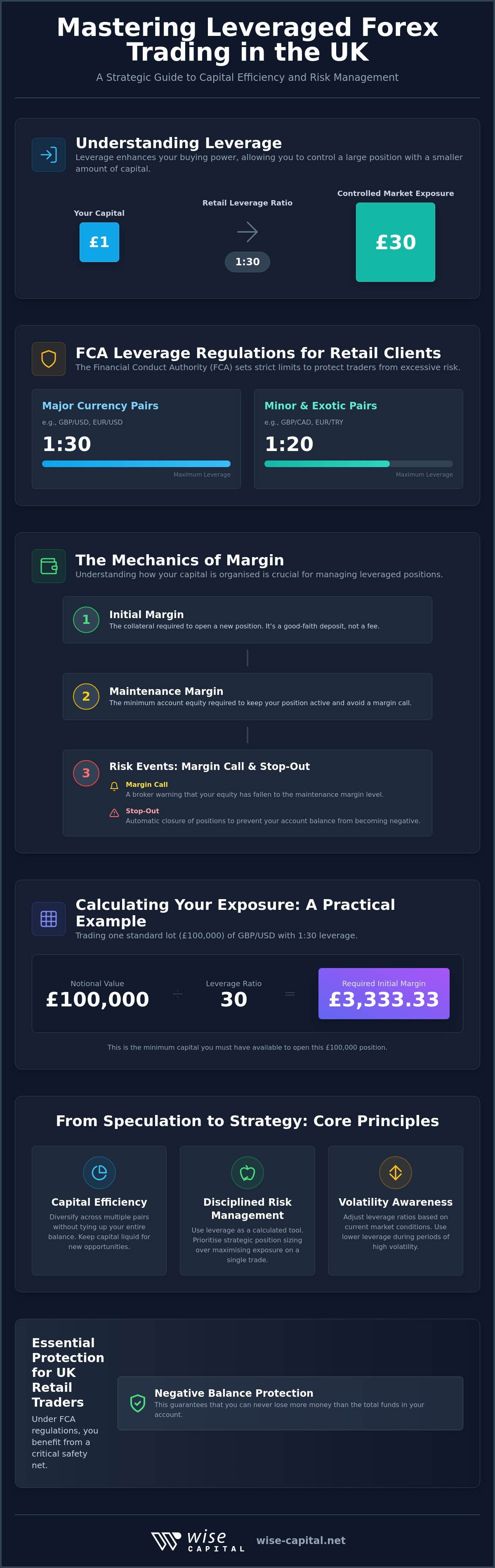
Leverage is a financial mechanism that allows a trader to control a large position using a relatively small amount of their own capital. In the context of leveraged forex trading uk, this is expressed as a ratio, such as 30:1. This means for every £1 deposited, a trader can access £30 of market exposure. It's a fundamental pillar of modern retail foreign exchange trading, providing the buying power necessary to participate in a market where daily price movements are often less than 1%.
A disciplined approach requires a clear distinction between the notional value of a trade and the margin required to sustain it. The notional value represents the total worth of the currency being controlled; the margin is the portion of your balance set aside as a good-faith deposit. Using a UK-regulated broker is essential for ensuring these deposits are held in segregated accounts and that execution remains fair. The Financial Conduct Authority (FCA) provides a structured framework that prioritises client security and operational transparency.
FCA Regulations and Leverage Limits in 2026
As of July 2026, the FCA maintains strict caps on leverage to protect retail participants from excessive volatility. For major currency pairs, such as GBP/USD or EUR/USD, the limit is capped at 1:30. Minor pairs and exotics, which typically exhibit higher volatility, are restricted to a 1:20 ratio. These limits ensure that traders maintain a sufficient capital buffer against market reversals. Experienced individuals may apply to become professional elective clients. This status allows for higher leverage ratios but requires meeting specific criteria regarding portfolio size, trading frequency, and professional history in the financial sector.
Why Capital Efficiency Matters for Active Traders
Capital efficiency is about more than just increasing position sizes. It enables a trader to diversify their portfolio across multiple currency pairs without exhausting their account balance. By using leverage, you can maintain significant market exposure whilst keeping a portion of your capital liquid for other opportunities or as a defensive reserve. This methodology mirrors institutional practices where capital is deployed strategically to manage risk rather than maximise speculation. Leverage is a strategic tool for magnifying market movements whilst keeping capital liquid.
The Mechanics of Margin: How Capital is Organised
Success in leveraged forex trading uk depends on understanding how your capital is partitioned within a live account. Initial margin refers to the specific deposit required to open a new position. It's best to view this as a collateral requirement rather than a transaction fee. Conversely, maintenance margin represents the minimum amount of equity you must hold in your account to keep that position active. If your account equity falls below this threshold, the broker's system will initiate protective measures to prevent your balance from slipping into the negative.
Price fluctuations are measured in pips, and these movements impact your equity balance in real-time. For a leveraged trade, even a minor pip movement has a magnified effect on your available capital. The bid-ask spread also impacts your available equity from the moment of execution. Because you buy at the higher "ask" price and sell at the lower "bid" price, every trade begins with a small unrealised loss. You must ensure your account has enough surplus equity above the initial margin to absorb this spread and any immediate adverse price action.
Margin Calls and Stop-Out Levels
When market movements go against your position, your equity decreases. If it hits the maintenance requirement, you'll receive a margin call. If no action is taken and equity continues to drop, the broker will reach a "stop-out level." At this point, positions are automatically closed to prevent further losses. Under FCA leverage restrictions, retail traders in the UK benefit from Negative Balance Protection. This ensures you can't lose more money than is in your account, providing a critical safety net during extreme market volatility.
Calculating Your Exposure: A Practical Example
Let's look at a practical scenario. Suppose you want to trade one standard lot of GBP/USD, which has a notional value of £100,000. With the standard retail leverage of 1:30, your required initial margin is 3.33% of that notional value. This means you'd need £3,333.33 in available equity to open the trade. It's important to remember that holding this position overnight incurs "swap" or financing fees. These costs are based on the interest rate differentials between the two currencies and can affect the long-term profitability of a leveraged trade.
Managing these variables requires a platform built for professional-grade transparency. You can explore disciplined trading environments that offer clear margin monitoring and real-time equity updates to help you stay in control of your exposure.
Strategy vs Speculation: Leverage as a Risk Management Tool
Professional traders view leverage as a mechanism for precision rather than a means of amplification. Successful leveraged forex trading uk requires moving away from the speculative "maximum leverage" mindset and towards a strategy focused on capital preservation. Instead of asking how large a position can be, the disciplined participant asks how much capital is at risk relative to market volatility. One effective method involves using the Average True Range (ATR) to gauge current price swings. When the ATR is high, reducing your leverage ratio helps maintain a consistent risk profile. Conversely, in quieter markets, leverage allows you to achieve meaningful exposure without overcommitting your liquid balance.
Psychological discipline is the silent variable in this equation. The ability to remain composed when gains and losses are amplified is what separates a strategic trader from a speculator. You must treat every trade as a single data point in a broader methodology, ensuring that emotions don't override your pre-defined risk parameters. By treating leverage as a tool for capital efficiency, you maintain the steady hand required to navigate the London market's inherent complexities.
The Position Sizing Methodology
A disciplined trader calculates risk as a fixed percentage of total account equity, often between 1% and 2%. Leverage facilitates this precision by allowing you to dial in the exact position size required to meet that percentage, even when trading smaller price movements. This approach prevents the catastrophic "over-leveraging" that often occurs during periods of high economic uncertainty. By prioritising the size of the position over the available leverage ratio, you ensure that your account can withstand a series of losses without compromising its long-term viability.
Using Guaranteed Stop-Loss Orders (GSLOs)
Standard stop-losses are essential, but they remain vulnerable to "gapping" during volatile UK trading sessions or major news releases. A Guaranteed Stop-Loss Order (GSLO) provides a hard ceiling on potential losses by ensuring your position is closed at your exact specified price, regardless of market slippage. Whilst GSLOs typically carry a small premium, they are a vital tool for managing leveraged forex trading uk exposure. Placing these stops amongst established support and resistance levels allows you to define your maximum risk with absolute certainty before the trade is even executed.
Execution Quality: Why Low Latency is Critical for Leverage
Execution quality is the silent determinant of profitability in leveraged forex trading uk. When you operate with amplified exposure, the precision of your entry and exit prices becomes paramount. Even a minor delay in order processing can result in slippage, which is the difference between your requested price and the price at which the trade is actually filled. On a non-leveraged trade, a one-pip slippage might be negligible. However, when controlling a position worth thirty times your deposit, that same slippage can significantly erode your margin and alter your planned risk-reward ratio before the trade has even begun.
The London trading session is the world's primary hub for currency liquidity, but it also presents periods of intense volatility. Institutional-grade execution speed is required to navigate these conditions effectively. A disciplined broker acts as a reliable bridge to global liquidity providers, ensuring that your orders are matched against the best available prices in the market. Tight bid-ask spreads are equally essential, particularly for high-frequency strategies where transaction costs can accumulate quickly. Transparent pricing ensures that the cost of doing business is clearly defined, allowing for more accurate capital allocation.
Slippage Prevention and Price Improvement
Fast execution models are designed to reduce the latency between order submission and market fill. This efficiency is vital during major economic announcements when prices move rapidly. Some advanced platforms also offer price improvement technology. This occurs when the market moves in your favour between the time an order is placed and when it's executed, allowing you to be filled at a better price than requested. Low-latency execution is the foundation of successful leveraged trading in volatile markets. It provides the stability needed to execute complex strategies without the interference of sub-optimal fills.
The STP/ECN Execution Model
To achieve this level of precision, many active traders prefer the Straight Through Processing (STP) or Electronic Communication Network (ECN) models. Unlike traditional market-making models, where a broker might take the opposite side of your trade, STP ensures your orders are sent directly to a pool of liquidity providers. The ECN environment offers even greater transparency by displaying the full depth of the market. This structure eliminates conflicts of interest and provides a neutral environment for high-volume trading. It allows you to interact with the market on a level playing field, focusing entirely on your methodology.
Maintaining this level of operational excellence is a core requirement for serious market participants. You can access institutional-grade execution and a transparent trading environment designed to support your long-term capital efficiency.
Navigating the UK Market with Wise Capital
Wise Capital provides a structured environment for market participants who prioritise operational stability and execution clarity. With over 15 years of experience in the industry, we have developed a methodology that values discipline over speculation. Success in leveraged forex trading uk is not just about the technical execution of a trade; it depends on the reliability of the partner providing the infrastructure. Our deep understanding of the UK regulatory landscape ensures that our services remain aligned with current standards, providing a secure and transparent foundation for active traders.
Our London-based support team offers responsive assistance, ensuring that technical or operational queries are handled with professional efficiency. We provide a transparent pricing structure designed to support high-volume participants who require predictable transaction costs. By removing the ambiguity often found in retail trading environments, we allow you to focus entirely on your methodology and capital management. This focus on operational excellence is why seasoned traders choose to partner with us to manage their market exposure.
Tools for Disciplined Execution
We provide access to institutional-grade platforms that allow for the precise management of complex leveraged positions. These tools include advanced order types and real-time margin monitoring to help you maintain control over your exposure at all times. To inform your strategy, we offer professional-grade market research and analysis. These insights help traders identify high-probability setups across major and minor currency pairs by examining market sentiment and technical trends. For those looking to refine their approach, our demo accounts provide a risk-free environment to practise margin management and test new strategies without committing actual capital.
Getting Started with a Regulated UK Broker
Opening an account with Wise Capital is a straightforward process designed for business-like efficiency. We provide a range of educational resources to help you understand the mechanics of the market and the nuances of leveraged forex trading uk. Our commitment to transparency means you will always have a clear view of your account equity, margin requirements, and trade history. Whether you are trading forex, indices, or commodities, our environment is built to support your long-term success through disciplined execution and institutional-grade support.
Open a professional trading account with Wise Capital today to access a reliable environment for your trading needs.
Advancing Your Strategy with Disciplined Capital Management
Mastering the mechanics of margin and the nuances of FCA regulations is the first step toward long-term success. You've seen that leverage is a tool for precision, not just a way to increase position sizes. By focusing on capital efficiency and institutional-grade execution, you move away from speculative behaviour and towards a professional methodology. Successful leveraged forex trading uk requires a steady hand and a platform that prioritises transparency over hype. It's about maintaining a structured environment where every pip movement is accounted for and every trade is executed with low-latency precision.
We provide the environment you need to execute with confidence. With over 15 years of market experience and London-based expert support, we understand the specific requirements of active UK traders. You can rely on our transparent institutional-grade execution to ensure your strategy remains intact even during periods of high volatility. This stability allows you to focus on your methodology rather than worrying about the mechanics of the platform. Start trading with a disciplined UK broker - Wise Capital. We're ready to provide the tools and support you need to trade with informed intent and professional control.
Frequently Asked Questions
What is the maximum leverage allowed for forex trading in the UK?
The maximum leverage for retail clients in the UK is capped at 30:1 for major currency pairs and 20:1 for non-major pairs. These restrictions are part of the Financial Conduct Authority (FCA) permanent rules designed to protect retail investors from excessive risk. Professional elective clients may access higher ratios, but they must meet specific regulatory criteria regarding their portfolio size and professional trading history.
Can I lose more than my initial deposit with leveraged trading?
No, retail traders in the UK cannot lose more than their initial deposit due to mandatory Negative Balance Protection. This safety mechanism ensures that your account balance never drops below zero, even during periods of extreme market volatility. It provides a critical safeguard for those engaged in leveraged forex trading uk, ensuring that you are never in debt to your broker following a market gap.
How is margin calculated for a GBP/USD trade?
To calculate the required margin, divide the total notional value of the position by your leverage ratio. For example, if you wish to control one standard lot of GBP/USD worth £100,000 at 1:30 leverage, the required margin is approximately £3,333.33. This amount is set aside as collateral whilst the position remains open, and your available equity must stay above the maintenance threshold to avoid a stop-out.
What is the difference between a retail and a professional trading account?
Retail accounts benefit from strict leverage caps and negative balance protection, whereas professional accounts offer higher leverage but fewer regulatory safeguards. To qualify as a professional elective client, you must meet at least two of three criteria: a financial portfolio exceeding £500,000, a history of significant trading frequency, or professional experience in the financial sector. Professional traders often lose access to certain protections like the Financial Services Compensation Scheme.
How do overnight swap fees affect leveraged positions?
Overnight swap fees are interest rate adjustments applied to positions held past the daily market close. Because leverage allows you to control a large notional value with a small deposit, these fees are calculated on the full size of the position rather than just your margin. This can significantly impact the net profitability of long-term trades, making swap rates a vital consideration for any disciplined trading strategy.
What happens if my account equity falls below the maintenance margin?
If your account equity falls below the maintenance margin threshold, the broker's system will initiate an automated stop-out to close your positions. This process typically begins when equity drops to 50% of the required margin for your open positions. It's a disciplined mechanism designed to protect your remaining capital and ensure the broker isn't exposed to negative balances during rapid price reversals.
Is leveraged forex trading suitable for beginners?
Leveraged trading is a high-risk activity that requires a significant level of market knowledge and risk discipline. Whilst it's accessible to beginners, it's essential to utilise educational resources and demo accounts before committing real capital. Understanding the mechanics of leveraged forex trading uk is vital for preventing rapid capital loss and ensuring you can manage the magnified volatility that leverage introduces.
How does Wise Capital ensure transparent execution for leveraged trades?
Wise Capital ensures transparent execution by utilising an STP/ECN model that connects traders directly to global liquidity providers. This approach eliminates the conflict of interest found in traditional market-making models where a broker might trade against its clients. By providing low-latency execution and tight bid-ask spreads, we ensure that every trade is filled at the best available market price with minimal slippage.