

Did you know that between 74% and 89% of retail investor accounts lose money when trading CFDs? This sobering statistic highlights why mastering disciplined share cfd trading strategies is more critical than ever. You likely recognise the frustration of seeing a promising setup undermined by inconsistent execution, slippage, or overnight financing costs that quietly erode your profit margins. It's difficult to maintain a competitive edge without a professional framework for entry and exit.
This guide provides a structured approach to organising your trading activities in 2026. We'll help you move beyond speculative hype by focusing on rigorous risk management and institutional-grade execution tools. You'll learn how to build a repeatable trading plan that reduces costs through better timing whilst providing transparent access to global equity markets. We'll examine the mechanics of managing swap rates and implementing precise order types to ensure you operate with the control and intent of a seasoned professional.
Key Takeaways
- Define the fundamental differences between asset ownership and price speculation to establish a professional, rules-based trading framework.
- Explore the three core pillars of share cfd trading strategies—day trading, swing trading, and hedging—and the technical indicators required to execute them.
- Master the calculation of total cost of ownership by evaluating how bid-ask spreads and overnight financing impact your long-term net returns.
- Build a repeatable trading plan that prioritises capital preservation through rigorous risk tolerance assessments and disciplined market selection.
- Learn to leverage institutional-grade execution and transparent market access to reduce slippage whilst improving your timing in global equity markets.
Understanding Share CFD Trading Strategies: A Disciplined Framework
Effective share cfd trading strategies aren't merely predictions about where a stock price might go. They're systematic frameworks designed to manage risk whilst exploiting market inefficiencies. Unlike traditional investing, where you purchase and hold a physical asset, a Contract for difference (CFD) is an agreement to exchange the difference in the value of a share between the time a contract is opened and when it's closed. This distinction is vital. You don't own the underlying stock; you speculate on its price trajectory without the need for physical asset delivery.
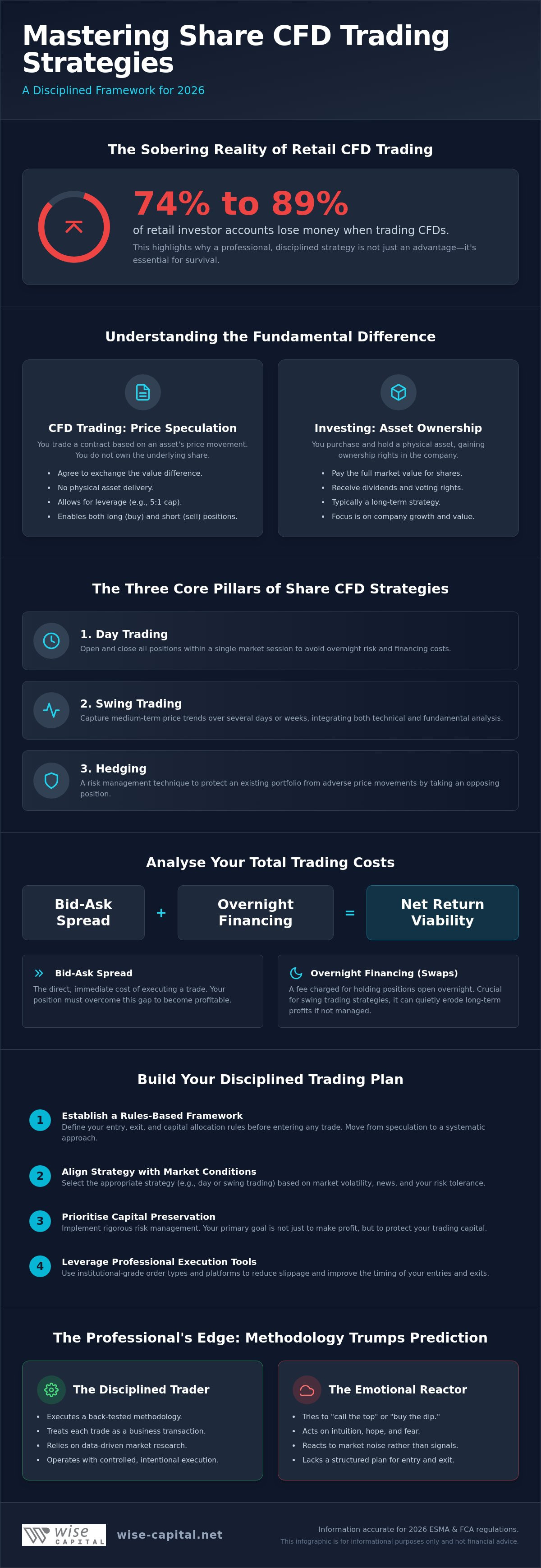
Discipline serves as the primary differentiator between professional execution and the high failure rates seen in retail trading. Verified data from 2026 shows that between 74% and 89% of retail investor accounts lose capital. These losses often stem from a lack of "strategy organisation"—the ability to align your trading style with specific market conditions. A disciplined trader treats every position as a business transaction, governed by pre-defined rules for entry, exit, and capital allocation. Without this structure, a trader is simply reacting to noise rather than following a plan.
The Mechanics of Contracts for Difference
A CFD functions as a flexible derivative. Instead of paying the full market value for a share, you deposit a margin to gain exposure. Under 2026 ESMA and FCA regulations, leverage for individual equities is capped at 5:1 for retail clients. This allows for greater capital efficiency, though it's essential to remember that leverage magnifies both profits and losses. Success also requires a keen focus on the bid-ask spread. This spread represents a direct cost of trading, and your strategy must account for it to ensure your net returns remain viable over time.
Why Methodology Trumps Prediction
Professional trading isn't gambling. It's the execution of a back-tested methodology. Whilst many traders focus on "calling the top" or "buying the dip" based on intuition, a professional relies on market research to validate a strategic thesis. This data-driven approach ensures that every trade is backed by evidence rather than emotion. For those interested in how these principles apply across other asset classes, our Forex Trading for Active Traders guide offers a deeper look at maintaining discipline in volatile environments. By prioritising methodology over prediction, you move from a state of uncertainty to one of controlled execution.
Core CFD Strategies for Global Equity Markets
Developing effective share cfd trading strategies requires a clear understanding of your time horizon and risk appetite. Most professional approaches fall into three primary categories: day trading, swing trading, and hedging. Each methodology demands different technical tools and mental discipline. For instance, active traders often rely on indicators like Moving Averages to identify trend direction and the Relative Strength Index (RSI) to spot overextended price action. Successfully applying these tools involves identifying high-volatility shares that offer enough price movement to cover execution costs. A fundamental grasp of how CFD trading works allows you to choose the pillar that best matches your operational capacity.
Intraday and Day Trading Methodologies
Day trading involves opening and closing all positions within a single market session. This approach is favoured by those who wish to avoid the unpredictability of "gap risk" that can occur when markets are closed. A common tactic is breakout trading, where you monitor 15-minute charts for price moves beyond established support or resistance levels. By exiting all positions before the market close, you effectively eliminate overnight financing costs. This disciplined daily exit ensures your capital isn't exposed to after-hours volatility or unexpected corporate news.
Swing Trading and Position Strategies
Swing trading focuses on capturing medium-term price trends in corporate equities over several days or weeks. This strategy often integrates fundamental analysis, such as earnings reports or sector shifts, with technical entry points. Whilst swing trading offers the potential for larger price captures, it introduces the reality of overnight swap fees. You must calculate these costs into your total profit targets to ensure the strategy remains viable. Many traders find that accessing transparent market research helps in identifying the structural trends necessary for successful swing positions.
Hedging: Protecting a Physical Portfolio
Hedging is a sophisticated use of share CFDs designed to offset potential losses in a traditional share portfolio. If you anticipate a temporary downturn in a stock you own physically, you can open a "short" CFD position on that same equity. If the price falls, the profit from the short CFD offsets the decline in your physical holdings. This allows you to protect your capital without the need to liquidate long-term investments. You should always perform a cost-benefit analysis to ensure the hedging costs don't exceed the potential protection value. Regardless of the strategy chosen, implementing a stop-loss order is a non-negotiable step in every setup to prevent catastrophic capital erosion.
Analysing Strategy Costs: Spreads vs Overnight Financing
To execute successful share cfd trading strategies, you must account for the total cost of ownership (TCO) beyond the initial margin. Many traders overlook how operational expenses can compound, turning a winning technical setup into a net loss. This is why the ESMA warning on speculative products emphasises the importance of understanding risk and cost structures before committing capital. Profitability isn't just about price direction; it's about the efficiency of your execution environment.
High-frequency strategies, such as scalping, are exceptionally sensitive to the bid-ask spread. Because these traders seek small price movements over short durations, a wide spread can consume a significant portion of potential gains. In contrast, longer-term strategies are less sensitive to the immediate spread but more vulnerable to holding costs. You should also consider the impact of slippage. This occurs when an order is filled at a price different from the one requested, often during periods of high volatility or low liquidity. In low-latency environments, even minor delays can result in hidden costs that skew your risk-to-reward ratio.
The Impact of the Bid-Ask Spread
The spread serves as the primary transaction cost for the broker and a hurdle for the trader. For those engaged in active stock trading, tight spreads are critical to ensuring that a position enters "the green" as quickly as possible. The spread is the difference between the buy price and the sell price quoted by Wise Capital. When selecting shares for a strategy, always compare the average spread against the expected price volatility to ensure the trade remains mathematically viable.
Understanding Overnight Swap Rates
Swing traders must manage overnight interest adjustments, commonly known as swaps. These fees are based on the interest rate differential between the currencies involved in the trade or the cost of carrying the leveraged equity position. When holding a position past the market close, these daily adjustments are applied to your account balance. To maintain a disciplined profit-and-loss projection, you should factor these fees into your exit targets from the outset.
Evaluating a broker's pricing transparency is a vital step in strategy organisation. Use the following checklist to assess your trading environment:
- Swap Visibility: Are the daily swap rates clearly displayed within the trading platform?
- Historical Spreads: Does the broker provide data on average spread fluctuations during peak market hours?
- Dividend Adjustments: Is there a transparent process for how dividends affect long and short CFD positions?
- Execution Speed: Does the platform offer low-latency execution to minimise the risk of slippage?
Step-by-Step: Building Your Disciplined Trading Plan
A successful trading career isn't built on a single lucky trade. It's constructed through the repeatable application of a disciplined plan. When refining your share cfd trading strategies, you must move from abstract ideas to a codified set of rules that dictate your market behaviour. This structure prevents emotional decision-making and ensures your capital is deployed with purpose.
- Step 1: Define Risk Tolerance. Start by defining your maximum capital allocation per position. In 2026, with retail leverage for equities capped at 5:1, your margin requirements are fixed. You shouldn't risk more than a small percentage of your total equity on any single contract to preserve your account balance.
- Step 2: Select Your Target Market. Focus on specific sectors or indices. You might specialise in UK Blue Chips for their relative stability or US Tech Indices for higher volatility. Concentrating on specific markets allows you to develop a deeper understanding of their unique price drivers.
- Step 3: Establish Entry and Exit Criteria. Use technical indicators to create non-negotiable triggers. Whether you use Moving Averages or the RSI, if your pre-defined criteria aren't met, the trade doesn't happen.
- Step 4: Execute with Precision. Use a professional trading platform with low-latency capabilities. In fast-moving equity markets, a delay of even a few milliseconds can impact your fill price and overall profitability.
- Step 5: Review and Adjust. Maintain a detailed trade journal to track your performance data. Reviewing this information helps you adjust your parameters based on evidence rather than impulse.
Integrating Market Research into Strategy
Economic calendars are essential for timing entries around corporate earnings reports. These events often trigger the volatility required for CFD positions. You should also use sentiment analysis to confirm that price action signals align with broader market psychology. For those looking to expand their sector-level research, our Index Trading Guide provides a detailed framework for 2026.
Managing Execution Quality and Slippage
Execution speed is a silent component of your strategy. Even the best plan fails if slippage erodes your entry price. During volatile sessions, use limit orders to control your entry point rather than relying on market orders. This prioritises price certainty over an immediate fill. Identifying a broker that provides institutional-grade execution ensures your orders are handled with precision. To start building your plan with a reliable partner, you can explore our professional execution environment designed for serious traders.
Executing with Wise Capital: The Professional Choice
Transitioning from a theoretical framework to live market participation requires a partner who prioritises stability and order. Wise Capital provides the structured environment necessary to execute your share cfd trading strategies with the precision they demand. With over 15 years of market experience, we understand that active traders value transparent execution quality over speculative hype. Our London-based institutional-grade support team acts as a steady hand, providing the responsive assistance required amongst today's fast-moving equity markets.
Success in CFD trading isn't just about the strategy itself; it's about the environment in which that strategy is deployed. When you move from planning to execution, you need to know that your broker's interests are aligned with your need for clarity and reliability. We focus on the practicalities of market access, ensuring that your journey from initial contact to final execution is seamless and professional. This methodical approach reflects the discipline we expect from our clients.
Institutional Grade Technology for Retail Traders
Our platform is built on low-latency technology designed to minimise slippage and ensure your orders are filled at the intended price. This focus on execution speed is a critical component of any professional trading plan, as even minor delays can impact your net returns. Within the platform, you'll find robust market research tools that help you validate your strategic thesis before committing capital. Wise Capital’s commitment to transparent pricing and execution ensures that you can calculate your costs with certainty, avoiding the hidden fees that often erode profit margins in less disciplined environments.
Next Steps: Opening Your Trading Account
Setting up your account is a straightforward process designed to get you into the market without unnecessary complexity. Whether you choose a live account for immediate execution or a demo account to refine your share cfd trading strategies, the focus remains on a methodical approach. We encourage all traders to start with a disciplined, small-scale strategy to test their rules in real-world conditions. This allows you to scale your activity as your confidence in your framework grows and your results stabilise.
Your transition to a professional trading environment begins with a single, informed choice. By partnering with an established entity that values methodology and operational efficiency, you provide yourself with the tools required for controlled intent. Refine your execution with Wise Capital today.
Refining Your Approach to Global Equity Markets
Building a sustainable presence in the markets requires more than a cursory understanding of price action. It demands a commitment to a repeatable, rules-based framework that prioritises capital preservation and operational efficiency. By mastering your share cfd trading strategies through rigorous risk management and a clear understanding of total cost of ownership, you position yourself amongst the disciplined minority of traders who operate with intent.
Success depends on your ability to align technical analysis with institutional-grade execution. Whether you're day trading to avoid overnight fees or hedging a physical portfolio, the quality of your platform remains a silent but decisive factor in your net results. Wise Capital provides the stable environment needed to turn these strategic concepts into precise market actions. With over 15 years of brokerage expertise, a transparent execution model, and London-based active trader support, we're here to facilitate your disciplined journey.
Open a Professional Trading Account with Wise Capital and begin executing with the clarity your plan deserves. We look forward to supporting your progress in the global markets.
Frequently Asked Questions
What is the most effective share CFD trading strategy for beginners?
For beginners, a trend-following approach focusing on large-cap equities is often the most effective. This method involves identifying established price directions using moving averages, which reduces the complexity of entry and exit decisions. It's a foundational part of many share cfd trading strategies because it prioritises capital preservation whilst allowing the trader to gain experience in liquid markets without the need for complex technical setups.
How much capital do I need to start trading share CFDs in the UK?
The capital required to start trading depends on your specific strategy and the margin requirements of your chosen broker. Under current regulations, retail clients must provide a 20% margin for individual equities, which equates to 5:1 leverage. It's vital to start with enough capital to withstand market volatility without triggering a margin call. Most disciplined traders suggest only risking a small percentage of total equity on any single position.
What are the main risks associated with leveraged CFD trading?
The primary risks include magnified losses and the potential for rapid capital depletion due to the use of leverage. Because you only deposit a fraction of the total trade value, even minor price movements against your position can result in significant losses. Statistics show that between 74% and 89% of retail investor accounts lose money when trading these products. It is essential to use stop-loss orders to mitigate these outcomes.
Can I use share CFDs to hedge my existing ISA or SIPP portfolio?
You can use share CFDs to hedge a physical portfolio by opening a short position on the same assets held in your ISA or SIPP. If the value of your physical shares falls, the profit from the short CFD position can offset those losses. This allows you to protect your long-term investments during temporary market downturns without having to liquidate your physical holdings. It's a tactical way to manage broader portfolio risk.
How are overnight financing fees calculated for share CFDs?
Overnight financing fees, or swaps, are calculated based on the total notional value of your position and the relevant interest rate benchmark. These fees are applied daily when a position remains open past the market close. The calculation typically involves an interest rate differential plus a small administrative fee. You should always factor these daily adjustments into your profit projections for medium-term share cfd trading strategies to ensure they remain viable.
What is the difference between a market order and a limit order in CFD trading?
A market order executes immediately at the best available current price, whilst a limit order only executes when the share reaches a specific price you define. Market orders prioritises speed of entry, which can be risky during high volatility due to potential slippage. Limit orders provide price certainty, ensuring you don't enter a position at an unfavourable rate. Choosing the right order type is a key part of disciplined strategy execution.
Why is execution speed important for active stock trading platforms?
Execution speed is critical because it directly impacts the fill price of your orders and reduces the risk of slippage. In fast-moving equity markets, a delay of even a few seconds can result in your trade being executed at a less favourable rate than you intended. High-quality platforms use low-latency technology to ensure that your strategic entry and exit points are respected, which helps in preserving your potential profit margins.
How does Wise Capital ensure transparent pricing for its clients?
Wise Capital ensures transparent pricing by providing clear bid-ask spreads and visible overnight swap rates within the trading platform. We draw on over 15 years of market experience to offer a structured environment where execution quality is prioritised over speculative hype. Our London-based support team is also available to assist active traders with any queries regarding fee structures or execution methodology, fostering a professional relationship built on clarity and trust.