
The FTSE 100 surpassed the 10,000 milestone in January 2026, yet many participants still struggle to capture these movements effectively due to market slippage and uncompetitive spreads. Successful index trading uk depends less on speculative market predictions and more on the precision of your execution and the transparency of your platform. You likely recognise the frustration of watching a well-timed trade eroded by hidden costs or emotional decision-making during periods of heightened volatility. It is difficult to maintain a disciplined strategy whilst the technical environment feels unpredictable or lacks transparency.
This guide provides a structured framework to help you master the mechanics of index trading with the composure of a seasoned professional. You will learn how to evaluate CFD mechanics, select indices based on objective criteria, and identify brokers that prioritise transparent execution over industry hype. We will examine the specific methods required to lower your trading costs and implement a methodical approach to global markets for the remainder of 2026. By the end of this article, you will have the tools to move from confusion to controlled, informed intent.
Key Takeaways
- Understand how indices function as statistical measures of market sectors, allowing for broad exposure without the requirement to purchase individual shares.
- Learn to select domestic and international markets to create a diversified strategy for index trading uk in the 2026 economic environment.
- Identify the essential criteria for choosing a platform, focusing on execution speed and transparent pricing to protect against hidden costs.
- Develop a disciplined methodology that replaces emotional decision-making with pre-defined entry and exit points for more consistent execution.
- Discover how institutional-grade tools and a structured environment can support a professional approach to global market movements.
Understanding Index Trading in the UK Market
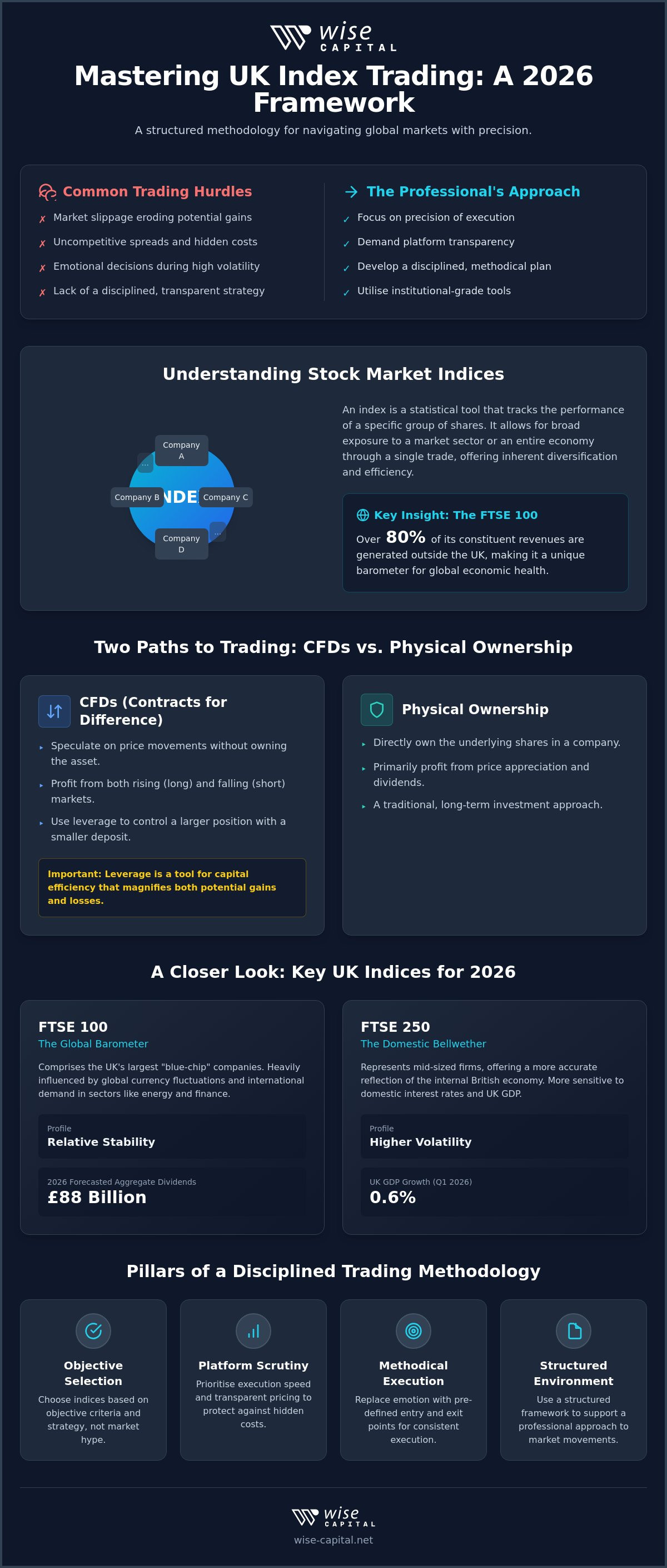
A Stock Market Index acts as a statistical tool that tracks the performance of a specific group of shares. When participating in index trading uk, you aren't just buying into a single company; you're gaining exposure to a broad section of the economy through a single trade. This approach is highly efficient for those who wish to speculate on macroeconomic trends without the complexity of managing a large portfolio of individual stocks. The UK market is particularly distinct due to its heavy concentration of global commodity giants and financial institutions. In 2026, the FTSE 100 remains a focal point for international investors because over 80% of its constituent revenues are generated outside the British Isles, making it a unique barometer for global economic health rather than just domestic performance.
Serious traders often use indices to hedge existing portfolios or to take advantage of volatility in specific sectors. For instance, with the GB100 trading around 10,472 points in July 2026, the index provides a liquid environment for executing high-volume strategies. Because indices represent a basket of assets, they generally offer lower idiosyncratic risk than individual shares. If one company within the index suffers a setback, the impact on the total index value is often mitigated by the performance of other members. This inherent diversification is a primary reason why indices are a preferred choice for disciplined, strategy-led trading.
The Mechanics of Stock Indices
Indices are constructed using specific methodologies, most commonly market-capitalisation weighting. In this system, companies with the largest total market value have the most significant impact on the index's price. Consequently, the movement of a few "heavyweight" stocks in the banking or energy sectors can drive the entire index's direction, even if smaller companies remain flat. An index constituent is a single company selected to represent a portion of the benchmark, ensuring the total calculation accurately reflects the collective performance of the target sector. Some indices use price-weighting, where the share price itself determines the influence, but market-cap weighting remains the standard for the UK's major benchmarks.
CFDs vs Physical Ownership
For active speculators, Contracts for Difference (CFDs) are the primary vehicle for index trading. Unlike traditional share dealing, CFDs don't require you to own the underlying asset. Instead, you're speculating on the price movement between the time the contract is opened and when it's closed. This allows for "shorting" the market, which is the ability to profit from falling prices as easily as rising ones. Leverage is a defining feature of CFD trading, enabling you to control a large position with a relatively small initial deposit. Whilst this can magnify your potential gains, it's vital to remember that it equally magnifies potential losses. A disciplined trader treats leverage as a tool for capital efficiency, not a reason for excessive risk-taking.
Selecting the Right Indices for Your Trading Strategy
Choosing which market to trade is a tactical decision that should align with your risk tolerance and operational schedule. In the context of index trading uk, participants often distinguish between "blue-chip" indices, which offer relative stability, and "mid-cap" indices that typically exhibit higher volatility. Understanding the nuances of UK financial markets regulation ensures you're operating within a structured framework whilst managing these varying risk profiles. A disciplined approach requires you to recognise that different indices react to different catalysts, whether they're domestic interest rate shifts or global commodity price swings.
Domestic Focus: The FTSE 100 and FTSE 250
The FTSE 100 serves as the primary benchmark for the UK's largest companies. Because a vast majority of its revenue originates overseas, it's heavily influenced by global currency fluctuations and international demand in sectors like pharmaceuticals, energy, and banking. With aggregate dividends forecast to reach £88 billion in 2026, it remains a cornerstone for those seeking exposure to established global giants. Conversely, the FTSE 250 provides a more accurate reflection of the internal British economy. It contains mid-sized firms that are often more sensitive to domestic interest rates and UK GDP growth, which reached 0.6% in the first quarter of 2026. This index usually presents more pronounced price swings, offering different opportunities for those who favour a more volatile environment.
Global Exposure: The S&P 500, DAX 40, and Beyond
Trading international indices from the UK offers significant liquidity and the advantage of extended market hours. The US markets, such as the S&P 500, provide a tech-heavy contrast to the "old economy" sectors dominant in the UK. British traders benefit from favourable time zones, as the US market open coincides with the UK afternoon. This overlap creates a period of high volume and narrowed spreads. Meanwhile, the DAX 40 allows you to speculate on Germany's industrial powerhouse, which often reacts sharply to European Central Bank policy and regional manufacturing data. Global news cycles ensure that these markets are constantly moving, providing 24-hour opportunities for those with a global outlook.
Successful execution requires a coordinated plan because global indices are frequently correlated. A major news event in New York often triggers a sympathetic reaction in London or Frankfurt. A disciplined trader monitors these relationships to avoid over-exposure to a single market sentiment. Using professional-grade market research and analysis can help you identify these correlations before they impact your capital, allowing for more methodical decision-making across diverse geographies. By categorising indices by their volatility and sector concentration, you can build a strategy that's resilient to local economic shifts.
Evaluating Index Trading Platforms and Execution Quality
Choosing a platform for index trading uk isn't merely about finding a user-friendly interface. It's about securing a technical infrastructure that can withstand periods of high-intensity volatility. When the Bank of England announces an interest rate decision or US inflation data is released, the speed at which your order reaches the market determines your actual entry price. A delay of even a few milliseconds can result in a filled price that differs significantly from your intended target. A professional platform should provide a structured environment that facilitates disciplined action rather than creating technical obstacles during critical market moments.
Transparency is equally vital for maintaining a profitable strategy. Many retail platforms mask their true costs within wide spreads or opaque fee structures that aren't immediately apparent. A professional-grade platform provides clear, upfront data on every trade, allowing you to calculate your exact cost of business. For UK participants, partnering with a UK-based expert offers an additional layer of reliability. Having access to support that understands the nuances of the local market and operates within the same time zone ensures that technical queries are resolved with efficiency and precision.
Transparent Pricing and Spreads
You should prioritise brokers that offer competitive spreads, whether they are fixed or variable. Variable spreads often narrow during peak liquidity, whilst fixed spreads provide cost certainty during quieter periods. Beyond the initial entry, you must consider the impact of overnight financing and swap fees. These costs apply to positions held past the daily market close and can erode the profitability of longer-term swing trades if not managed carefully. The bid-ask spread is the primary cost of index entry, representing the difference between the price you pay to buy and the price you receive to sell.
Execution Speed and Slippage Prevention
Slippage occurs when a trade is executed at a price different from the one requested, often during rapid market movements. High-quality execution models mitigate this by using low-latency connections directly to liquidity providers. For active index speculators, these technical details aren't optional; they are fundamental to maintaining a disciplined methodology. Integrating slippage prevention into your broader trading methodology involves choosing a partner that prioritises order integrity over marketing hype. This methodical approach ensures that your trading environment remains stable, allowing you to focus on strategy rather than technical failures. Reliability in your platform's performance is the cornerstone of professional execution.
Developing a Disciplined Index Trading Methodology
Successful index trading uk is rarely the result of a single brilliant prediction. It's the outcome of a rigorous, repeatable process. Whilst many participants focus on finding a complex strategy, experienced traders recognise that success is 10% strategy and 90% discipline. A strategy provides the map, but discipline is the act of following it without deviation when market conditions become challenging. This methodical approach requires you to establish pre-defined entry and exit points before a trade is even placed, removing the emotional friction that often leads to impulsive decision-making.
A serious participant treats trading as a business of capital preservation. This involves a commitment to continuous education and a refusal to be swayed by short-term market noise. By maintaining a structured environment, you can execute trades with the quiet confidence of an established professional. Discipline is the differentiator between those who speculate and those who trade with intent.
Technical Analysis vs Fundamental Drivers
Timing your entries requires a balance between technical levels and fundamental catalysts. Many traders use support and resistance levels to identify areas of high liquidity where price reversals or breakouts are likely to occur. However, these technical signals must be viewed through the lens of macroeconomic data. For example, the Bank of England's interest rate decision in May 2026, which held the Bank Rate at 3.75%, created specific volatility windows for the FTSE 100. Similarly, inflation cooling to 2.8% in April 2026 provided a fundamental backdrop that influenced index direction. Using an economic calendar allows you to plan your trading week around these high-impact events, ensuring you aren't caught off guard by sudden shifts in sentiment.
Risk Management and Leverage Control
Preserving your equity is the most critical component of a professional methodology. Leverage is a powerful tool for capital efficiency, but it must be treated with respect to avoid significant losses. A disciplined framework involves setting automated stop-loss orders for every position to ensure an exit is executed if the market moves against you. Position sizing is equally vital; you should never risk more than a small, predetermined percentage of your total equity on a single trade. This approach provides a psychological benefit, as it reduces the stress associated with individual market movements. When your risk is controlled, you can focus on the quality of your execution rather than the fear of a single loss. Serious traders require an environment that supports these rigorous standards. You can access the tools and support necessary for this methodical approach through professional index trading services that prioritise order and methodology.
Navigating UK Index Markets with Wise Capital
Engaging in index trading uk requires more than just a functional platform; it demands a partnership with an entity that understands the necessity of order and precision. Wise Capital provides the steady hand and professional environment that serious traders require to execute their strategies with composure. With over 15 years of market experience, we've developed a deep understanding of index market nuances, from the global revenue drivers of the FTSE 100 to the domestic sensitivities of the FTSE 250. Our focus remains on providing a structured environment where execution is transparent and technical obstacles are minimised.
We prioritise a disciplined approach to the markets, moving away from the speculative hype that often characterises the industry. By focusing on the practicalities of execution and support, we help you maintain your trading discipline even during periods of extreme volatility. You can access global markets whilst benefitting from our London-based expertise, ensuring that your trading activities are supported by a team that operates within your own regulatory and economic context. This local presence provides a level of accountability and responsiveness that larger, impersonal global entities often struggle to match.
Professional Support for Active Traders
Active traders require direct access to responsive support teams who possess a sophisticated understanding of the UK market. At Wise Capital, we're committed to clarity in all client communications, ensuring that every interaction is business-like and efficient. Our institutional-grade execution model is specifically designed to serve the needs of retail professionals who value price integrity and speed. We don't attempt to be a casual acquaintance; instead, we maintain a respectful, expert distance whilst remaining highly supportive. This approach ensures that you have the tools and the environment to act with control and informed intent at all times.
Advanced Research and Analytical Tools
Successful index trading is built on methodical planning rather than guesswork. You can utilise our market research and analysis to inform your strategies, moving from high-level objectives to specific operational capabilities with ease. Our practical tools are designed to facilitate this transition, providing the data necessary for disciplined execution. By joining a community of traders who value strategy over speculation, you align yourself with a methodology that prioritises long-term capital preservation. Our research doesn't just provide market commentary; it offers a structured framework for understanding the fundamental and technical drivers that move global indices. This commitment to order ensures that every trade you place is backed by a consistent, professional rationale.
Master Your Approach to Global Indices
Success in the coming year depends on your ability to replace emotional reactions with a repeatable, disciplined methodology. You have learned that selecting the right benchmark and prioritising execution quality are essential steps in protecting your capital. By focusing on transparent pricing and automated risk management, you can maintain the composure required for long-term participation in the markets. A professional environment isn't just a convenience; it's a fundamental requirement for those who trade with serious intent.
Wise Capital provides the steady hand you need to navigate index trading uk. Our 15+ years of market experience and transparent execution models ensure that your strategy is supported by institutional-grade infrastructure. Benefit from London-based expert support that understands the specific nuances of the British and global economic landscape. You are now prepared to execute your trades with the quiet confidence of a seasoned professional.
Open a professional trading account with Wise Capital today and take control of your market execution.
Frequently Asked Questions
What is the most traded stock index in the UK?
The FTSE 100 is the most traded stock index in the UK. It tracks the performance of the 100 largest companies listed on the London Stock Exchange by market capitalisation. Traders value this index for its high liquidity and its role as a primary barometer for global economic sentiment, given that many of its constituents are multinational corporations.
Can I trade global indices like the S&P 500 from the UK?
You can trade global indices including the S&P 500, DAX 40, and Nikkei 225 whilst based in the UK. Most professional platforms provide access to these markets through CFDs, allowing for 24-hour exposure. This enables you to participate in index trading uk whilst diversifying your strategy across different geographical regions and time zones.
How much capital do I need to start index trading?
The capital required depends on your broker's minimum deposit and the specific margin requirements for your chosen index. Under FCA regulations, retail traders typically provide a 5% margin for major indices, which represents 20:1 leverage. This means you could control a position worth £2,000 with an initial deposit of £100, though maintaining a larger capital buffer is advisable for risk management.
Is index trading safer than trading individual shares?
Index trading generally offers lower idiosyncratic risk because it provides inherent diversification across a basket of assets. The poor performance of a single company has a mitigated impact on the total index value compared to a single share holding. However, indices remain subject to systematic market risks and broader economic volatility, requiring the same disciplined execution as any other asset class.
What are the main costs associated with index CFD trading?
The primary costs are the bid-ask spread and overnight financing charges, often referred to as swap fees. These financing costs apply if you hold a position past the daily market close. Notably, CFD trading in the UK does not currently attract Stamp Duty Reserve Tax, which can make it more cost-effective for active speculators compared to physical share ownership.
How does leverage work in UK index trading?
Leverage allows you to control a large market position with a relatively small amount of capital. In the UK, the Financial Conduct Authority limits leverage for retail traders on major indices to 20:1. Whilst this tool magnifies your potential for profit, it equally magnifies your potential for loss. A professional approach involves using leverage as a capital efficiency tool rather than a means for excessive risk.
What are the best times of day to trade the FTSE 100?
The most effective times to trade the FTSE 100 are during the London market open at 08:00 and the US market overlap starting at 14:30 GMT. These windows typically experience the highest trading volumes and the narrowest spreads. Increased volatility during the first and last hour of the London session provides the most frequent opportunities for active traders to execute their strategies.
Do I need a specific trading account for indices?
Most professional CFD accounts provide integrated access to indices, forex, and commodities within a single environment. You don't usually require a separate account dedicated solely to index markets. Wise Capital offers a unified platform where you can manage your index trading strategies alongside other asset classes, ensuring all your market activities are conducted under a single, disciplined framework.