

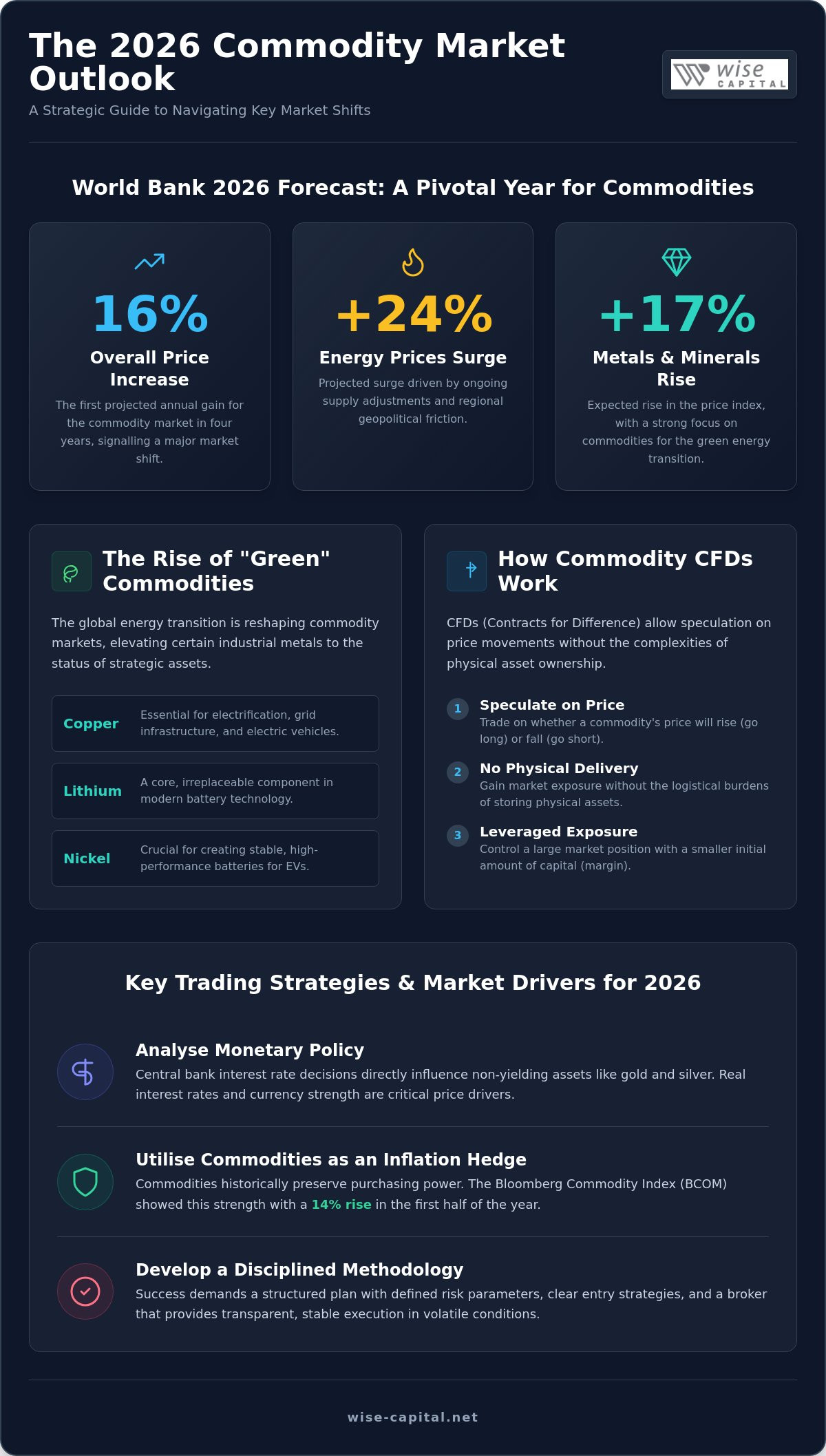
The World Bank forecasts a 16% overall increase in commodity prices for 2026, marking the first annual gain the market has seen in four years. You likely recognise that entering such a pivotal year requires more than just a directional bias; it demands a trading environment that remains stable when volatility spikes. Many traders struggle with high slippage and opaque costs when they need transparency most. Finding a reliable commodity cfd broker becomes a matter of operational necessity rather than mere preference.
This article will help you understand the macro forces shaping the next twelve months and teach you how to identify execution models that protect your capital. We examine the projected 17% rise in the metals and minerals index alongside a 24% surge in energy prices. You will also learn to navigate the specific regulatory shifts and professional research tools that define disciplined trading in 2026. By focusing on methodology and transparent pricing, you can move away from speculative hype and toward a more structured approach to the global markets.
Key Takeaways
- Examine how the global energy transition and the rise of "green" commodities are creating new strategic opportunities within the 2026 market landscape.
- Identify the essential criteria for choosing a commodity cfd broker that emphasises transparent execution and operational stability during periods of high volatility.
- Master the development of a disciplined trading plan that clearly defines risk parameters and entry strategies based on fundamental market drivers.
- Analyse the relationship between safe-haven demand and real interest rates to better forecast precious metal movements and hedge against inflation.
- Learn how to utilise leveraged derivative structures to gain efficient market exposure without the logistical requirement for physical asset delivery.
The Evolving Landscape of Global Commodity Markets in 2026
The 2026 market presents a distinct shift in how raw materials are valued. Industrial metals required for the global energy transition, such as copper, lithium, and nickel, have become central to international supply chains. These "green" commodities are no longer just industrial inputs; they are strategic assets. As the World Bank expects the metals and minerals price index to rise by 17% this year, active traders are increasingly looking toward a Contract for Difference (CFD) model to gain exposure without the burden of physical delivery. Working with a specialised commodity cfd broker allows for the flexibility to go long or short on these transition metals as supply dynamics evolve.
Geopolitical stability remains a primary driver of price action. Ongoing supply adjustments and regional tensions continue to create friction, particularly in the energy sector where prices are projected to increase by 24%. This inherent volatility attracts those who find traditional equity markets too restrictive or stagnant. By partnering with a disciplined commodity cfd broker, traders can access these fast-moving markets with professional-grade execution and transparent pricing. Tangible value drivers matter. This shift from equities to hard assets represents a move toward markets that respond directly to supply and demand imbalances.
Commodities as a Strategic Diversification Tool
Effective diversification in 2026 requires more than a mix of domestic shares. Adding energy and metal exposures can significantly reduce portfolio correlation. Many participants closely monitor index trading uk trends to anticipate broader market shifts. Because major equity indices often lead commodity movements, understanding this relationship is vital for a structured methodology. This integrated view allows for better timing when entering positions.
The Impact of Monetary Policy on Hard Assets
Central bank interest rate decisions directly influence the price of non-yielding assets like gold and silver. When real interest rates fluctuate, the opportunity cost of holding precious metals changes rapidly. Since most global commodities are dollar-denominated, currency strength remains a critical factor in price discovery. The 2026 environment rewards those who employ technical analysis rather than relying on simple "buy and hold" strategies. Precision is paramount here.
Commodities have historically served as a robust hedge against persistent inflation. In 2026, this role is more pronounced as global economies grapple with structural price increases. The Bloomberg Commodity Index (BCOM) already demonstrated this strength with a 14% rise in the first half of the year. Traders use these assets to preserve purchasing power when fiat currencies lose value. This approach requires a steady hand and a clear understanding of macro trends. Markets move fast. Having a structured environment for execution ensures that you can react to these inflationary signals without unnecessary delay or complexity.
The Structural Mechanics of Commodity CFDs
A Contract for Difference (CFD) is a derivative instrument that allows market participants to speculate on price movements without owning the underlying asset. In this arrangement, the buyer and seller agree to exchange the difference between the opening and closing prices of a contract. A commodity cfd broker acts as an intermediary providing price exposure without physical delivery. This structure is particularly advantageous for those trading bulky or perishable goods like crude oil or wheat, where the logistics of physical settlement would be impractical for most active participants.
Execution quality depends heavily on the bid-ask spread, which represents the difference between the price at which you can buy and the price at which you can sell. In volatile sessions, these spreads can widen, impacting the total cost of your trade. Professional traders often consult CFTC Commitments of Traders data to gauge how institutional players are positioned before they commit capital. Understanding these mechanics ensures that you aren't caught off guard by the technical realities of the market. Choosing a partner that prioritises commodity cfd broker transparency is the first step toward a disciplined strategy.
Leverage and Margin Requirements
Leverage is a core component of CFD trading, allowing you to control a large position with a relatively small amount of equity. Whilst this amplifies potential gains, it also increases the risk of significant losses. In the UK, regulations typically cap leverage at 20:1 for gold and 10:1 for other commodities to protect retail participants. You must maintain adequate account equity to cover your margin requirements. If your balance falls below a certain threshold, the broker may issue a margin call or automatically liquidate positions to prevent a negative balance. Maintaining a buffer is essential for long-term stability.
Overnight Financing and Swap Fees
Because CFDs are leveraged products, holding a position open past the daily market close incurs an overnight financing charge, often called a swap fee. This fee is calculated based on the total value of your position and current benchmark interest rates. It's vital to factor these costs into your trading plan, especially if you intend to hold trades for several days or weeks. Opaque fee structures can erode profits quickly; therefore, identifying a firm with a clear methodology is critical. For those seeking a structured environment, accessing transparent execution models can help you manage these operational costs more effectively.
Macro Trends Impacting Energy and Precious Metal Sectors
The 2026 outlook for commodities is defined by a clear divergence in sector performance. Whilst industrial demand drives base metals, precious metals respond to the shifting dynamics of global currency stability and real interest rates. Professional traders often look to the World Bank Commodity Markets Outlook to align their strategies with these high-level forecasts. Identifying a reliable commodity cfd broker is essential for navigating these shifts, as institutional-grade execution becomes the deciding factor in capturing price movements during volatile sessions.
Energy Sector: Oil and Natural Gas Volatility
OPEC+ remains a dominant force in 2026, managing supply to counter-balance fluctuating global demand. Crude oil prices, such as Brent at $83/bbl in early July, reflect the ongoing tension between supply adjustments and economic cooling. The transition from fossil fuels is no longer a distant prospect; it's a present reality impacting long-term speculation. Energy price shocks don't exist in a vacuum. They ripple through financial markets, affecting everything from transport costs to consumer price indices. A disciplined commodity cfd broker provides the tools necessary to trade these fluctuations with precision, allowing for responsive adjustments as geopolitical headlines break.
Precious Metals: Gold and Silver as Strategic Assets
Gold continues to serve as a primary safe-haven asset, especially when currency devaluation concerns arise. Its performance in 2026 is a tug-of-war between safe-haven demand and real interest rate trends. Central bank gold reserves act as a critical sentiment indicator; when global institutions increase their holdings, it often signals a cautious outlook on fiat stability. Silver, meanwhile, occupies a unique position amongst hard assets. It functions as both a monetary metal and an essential industrial component for solar technology and electronics. This dual role often leads to higher volatility than gold, rewarding those who use professional-grade research to time their entries.
Industrial and "soft" commodities are also facing structural shifts. Copper and Lithium have become the backbone of the "New Economy," with demand frequently outstripping supply as electrification accelerates. Simultaneously, soft commodities like wheat and coffee are reacting to 2026 climate patterns, which have introduced unpredictable harvest cycles. These markets require a nuanced approach. Traders move away from generic predictions and toward specific data points, such as the 7.3% increase in U.S. natural gas prices seen in June 2026. This level of detail is what separates a methodical participant from a speculative one.
Developing a Disciplined Methodology for Commodity Trading
Trading commodities in 2026 requires a shift from speculative guessing to a methodology rooted in verifiable data. High volatility in energy and metals, as seen with the 20.6% drop in Brent crude earlier this year, demands a trading plan that dictates entry and exit points before a position is opened. A structured approach allows you to filter out market noise and focus on high-probability setups. By combining fundamental analysis, such as monitoring global supply disruptions, with technical indicators, you create a more resilient strategy. Selecting a commodity cfd broker that provides institutional-grade execution speed is the foundation of this professional process.
Risk Management Frameworks
Protecting capital is the first priority for any serious participant. Market gaps can occur during volatile sessions, making the use of stop-loss orders essential for risk mitigation. You should also focus on position sizing to ensure no single trade endangers your entire account equity. Many of the principles found in forex trading for active traders are directly transferable to the commodity markets. Both require a deep understanding of liquidity and margin requirements. By applying these disciplined risk management rules, you can navigate the 10:1 leverage limits common amongst UK-regulated firms without overextending your exposure.
Utilising Advanced Trading Tools
Professional-grade research tools are necessary to validate your strategic hypotheses. Real-time charting and technical indicators help identify support and resistance levels in markets like gold, which saw a 9.2% decline in June 2026. Economic calendars are equally vital; they allow you to prepare for high-impact data releases, such as central bank interest rate decisions or OPEC+ supply reports. A reliable commodity cfd broker offers these tools to help you maintain a steady hand whilst markets move rapidly. Accessing institutional-grade data ensures your decisions are based on the same information available to professional desk traders.
Maintaining emotional composure is often the most difficult aspect of trading. When prices for natural gas surge by 7.3% in a single month, it's easy to abandon a plan in favour of reactive decisions. A disciplined methodology acts as an anchor during these periods. It ensures that every action is intentional and based on pre-defined parameters rather than impulse. Precision matters more than pace in these environments. To support your strategic planning and execution, access our professional-grade market research and analysis tools today.
Evaluating a Transparent Commodity CFD Broker for Professional Execution
Choosing a commodity cfd broker is a strategic decision that determines the efficacy of your trading methodology. In 2026, where market dynamics are increasingly complex, a broker's track record serves as a primary indicator of stability. A firm with over 15 years of operational experience has successfully navigated various economic climates, including the sharp 20.6% drop in Brent crude seen in mid-2026. This level of experience suggests a mature infrastructure that can handle high-volume sessions without compromising on execution quality. It's about finding a partner that values order over speculative hype.
Transparency in pricing and execution models is non-negotiable for the disciplined participant. You must be able to verify how your orders are processed and what costs are being applied to your positions. Opaque fee structures or hidden markups can quickly undermine even the most sophisticated strategy. A reliable partner provides clear documentation and responsive, trader-focused support that addresses technical queries with precision. This is particularly important in the UK, where regulatory standards for disclosure remain stringent. Support should be expert-led, ensuring that you aren't left without guidance during volatile periods.
Execution Quality and Slippage Prevention
Execution speed is not just a technical metric; it's a risk management tool. Low-latency technology ensures that your orders are filled as close to your requested price as possible. This is vital when trading commodities like natural gas, which saw a 7.3% increase in June 2026. Market execution models, where orders are filled at the best available price in the pool, often provide better transparency than instant execution models that may result in frequent re-quotes. Active traders require institutional-grade technology to prevent excessive slippage from eroding their margins during fast-moving sessions.
The Wise Capital Advantage
Wise Capital positions itself as a steady hand for a serious and active clientele. Our commitment to disciplined execution and order provides a structured environment where you can act with informed intent. With over 15 years of brokerage experience, we understand the practicalities of market access and the necessity of transparent pricing. We provide the professional-grade research and analysis tools required to navigate the 2026 market outlook with control. By prioritising operational efficiency and responsiveness, we ensure that our clients have the reliable service they need to manage their leveraged positions effectively. We don't just provide access; we provide a foundation for methodical trading.
Strategic Positioning for the 2026 Commodity Cycle
The 2026 commodity markets require a transition from speculative entries to a structured methodology. You've seen how macro trends, such as the projected 17% rise in industrial metals, demand a disciplined approach to risk management and order execution. Success in this environment depends on your ability to process real-time data and maintain emotional composure during volatile sessions. Finding a reliable commodity cfd broker that prioritises transparency ensures your strategy isn't undermined by opaque costs or high slippage.
By aligning with a firm that offers over 15 years of brokerage experience and a disciplined execution model, you gain the stability needed to navigate global supply shocks. Expert market analysis tools allow you to validate your hypotheses with institutional-grade precision. It's time to move toward a more methodical trading environment. Open a professional trading account with Wise Capital today to access the tools and support required for the year ahead. We look forward to supporting your journey through the evolving global markets.
Frequently Asked Questions
What is a commodity CFD broker and how does it differ from a traditional broker?
A commodity cfd broker acts as an intermediary that allows you to speculate on the price movements of raw materials without requiring physical ownership or delivery of the assets. Traditional brokers often deal in physical commodities or exchange-traded futures that involve complex logistics and higher capital requirements. In contrast, CFD brokers offer cash-settled contracts, providing a more streamlined way to gain exposure to markets like crude oil, gold, and wheat through a single digital interface.
Is commodity CFD trading suitable for beginners in 2026?
Commodity CFD trading is suitable for those who are committed to a disciplined methodology and a structured learning process. Whilst the entry barriers are lower than traditional futures markets, the 2026 landscape is defined by high volatility that can be challenging for the unprepared. Beginners should prioritise using professional-grade research tools and starting with smaller position sizes to manage the risks associated with leveraged trading effectively. It isn't a speculative hobby; it's a professional activity that rewards methodical planning.
How much leverage can I use when trading commodities in the UK?
In the UK, retail leverage limits are strictly regulated to protect traders from excessive market exposure. You can typically access leverage of up to 20:1 for gold and 10:1 for other commodities like crude oil or natural gas. These limits mean you can control a position worth ten or twenty times your initial deposit. Whilst leverage amplifies potential gains, it also increases the risk of significant losses, making it vital to maintain adequate account equity at all times.
What are the main risks associated with trading oil and gold CFDs?
The primary risks include rapid market volatility, slippage during high-impact news events, and the potential for losses to exceed initial expectations due to leverage. For instance, Brent crude oil experienced a 20.6% drop in June 2026, demonstrating how quickly supply dynamics can shift. Gold is equally sensitive to real interest rate changes and currency fluctuations. Without a clear trading plan and the use of stop-loss orders, these price swings can lead to substantial drawdowns in a very short period.
How do overnight financing fees work for commodity positions?
Overnight financing fees, often called swap rates, are interest adjustments applied to leveraged positions held open past the daily market close. These fees reflect the cost of borrowing the capital used to maintain your position and are calculated based on benchmark interest rates plus a small broker markup. It's essential to choose a commodity cfd broker with a transparent fee structure so you can accurately factor these operational costs into your long-term trading strategy and avoid hidden charges.
Can I trade commodities on a mobile platform with Wise Capital?
Yes, you can manage your commodity positions through our professional mobile platform, which is designed for disciplined execution on the move. The platform provides real-time charting, technical indicators, and instant access to global markets, ensuring you don't lose operational control when away from your desk. This mobile access allows you to react to 2026 market headlines with the same precision and stability found in a traditional desktop environment.
Which commodities are expected to be the most volatile in 2026?
Energy products and transition metals are projected to experience the highest levels of volatility throughout 2026. Natural gas prices have already seen sharp movements, including a 7.3% increase in June, whilst the broader energy sector is forecast for a 24% annual rise. Industrial metals like copper and lithium are also subject to significant price swings as the global "green" transition creates structural supply deficits that a commodity cfd broker can help you navigate through various market cycles.