

The headline rate you pay for share trading commissions uk is often the least significant factor in your total cost of execution. Whilst many traders fixate on whether a broker charges a flat fee or a tiered percentage, the true erosion of capital frequently occurs in the shadows of the bid-ask spread. You've likely noticed that even a "low-cost" trade becomes expensive when execution quality is poor or hidden costs are factored into the final price. It's a common frustration for those seeking a disciplined, professional approach to the markets.
This guide will help you master the complexities of execution costs so you can protect your portfolio from unnecessary friction. You'll learn how to evaluate the synergy between commission structures and market spreads to ensure your strategy is fully optimised. We'll provide a structured framework for comparing broker models, helping you select a partner that prioritises transparency and supports your long-term trading objectives through methodical planning and operational excellence.
Key Takeaways
- Learn to distinguish between retail flat fees and professional tiered models to identify the most efficient cost structure for your trading volume.
- Understand why the bid-ask spread often represents a more significant execution cost than the explicit commission charged by your broker.
- Identify how regulatory requirements, including Stamp Duty Reserve Tax (SDRT) and PTM levies, impact your total transactional friction.
- Master a framework for comparing share trading commissions uk and overnight financing rates to optimise your capital preservation strategy.
- Discover how transparent execution models and institutional-grade tools provide the clarity required for disciplined, professional market participation.
The Landscape of Share Trading Commissions in the UK
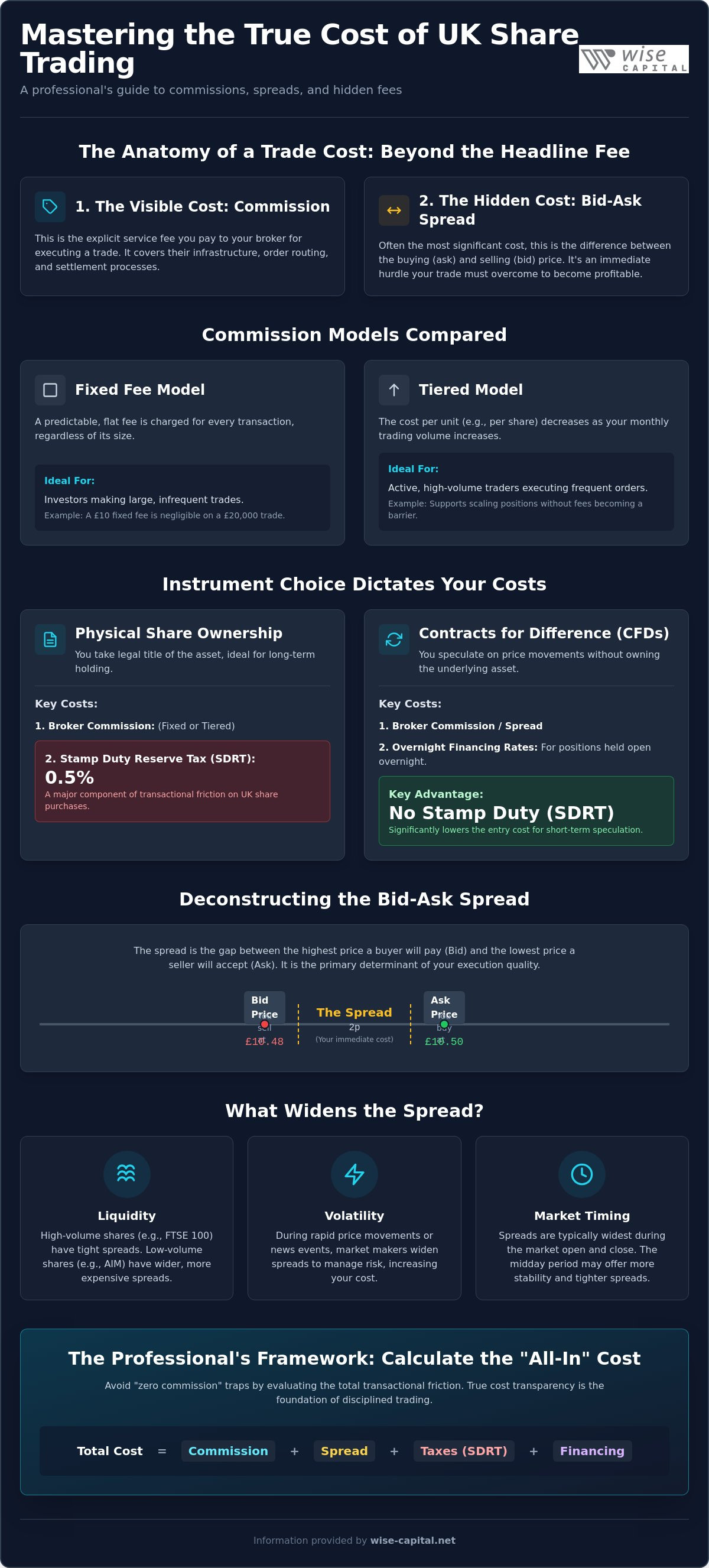
Analysing share trading commissions uk requires a shift from viewing fees as a nuisance to seeing them as a manageable overhead. A commission is essentially the service fee paid to an intermediary for facilitating your access to the market. This charge covers the technical infrastructure, order routing, and settlement processes required to execute a trade on the London Stock Exchange or other global venues. A foundational step in understanding the role of a stockbroker involves recognising how these compensation models align with different levels of market activity. Unlike the US market, where "zero-commission" models are common, the UK regulatory environment prohibits payment for order flow. This means that "free" trading platforms often recover their costs through wider bid-ask spreads or substantial foreign exchange conversion fees. Professional traders avoid these marketing traps by seeking transparent fee structures that don't compromise execution quality.
Fixed vs Tiered Commission Models
Fixed commission models offer a predictable, flat fee for every transaction. This structure is often the preferred choice for investors who execute large, infrequent trades. If you're moving £20,000 in a single block, a £10 fixed fee is negligible. However, for active participants, these costs quickly accumulate. High-volume traders typically benefit more from tiered share trading commissions uk. In a tiered system, the cost per unit decreases as your monthly trading volume grows. This model supports a more agile strategy, allowing you to scale positions or enter and exit trades frequently without the fee structure becoming a barrier to profitability. Identifying the right model depends entirely on your projected trade frequency and the average size of your orders.
CFD Share Trading vs Physical Ownership
The total cost of a trade changes significantly depending on whether you're buying physical shares or trading derivatives like Contracts for Difference (CFDs). Physical ownership in the UK usually incurs a 0.5% Stamp Duty Reserve Tax (SDRT) on top of the broker's commission. This tax is a major component of transactional friction for those holding long-term positions. CFD trading generally avoids SDRT because you're speculating on price movements rather than taking legal title to the asset. Whilst this can lower the entry cost, you must account for overnight financing rates and the impact of leverage. Leverage allows you to control a larger market exposure with less capital, which can make the effective commission rate lower relative to the total value of the position. Disciplined traders evaluate these factors to ensure their chosen instrument matches their specific capital preservation goals.
Understanding the Bid-Ask Spread: The Hidden Cost of Execution
While headline share trading commissions uk are highly visible, the bid-ask spread often constitutes the largest portion of your total execution cost. The spread is the price gap between the highest price a buyer is willing to pay (the bid) and the lowest price a seller is willing to accept (the ask). For an active trader, this gap represents an immediate hurdle that must be overcome before a position becomes profitable. The bid-ask spread represents the immediate loss a trader incurs upon entering a position before any subsequent price movement occurs. In the UK market, where liquidity varies significantly across different indices, failing to account for this spread can lead to substantial capital erosion over time.
Factors Influencing Spread Width in the UK
Liquidity is the primary determinant of spread width on the London Stock Exchange. Large-cap "Blue Chip" shares in the FTSE 100 typically offer the tightest spreads, often ranging between 1 and 5 pence due to the high volume of daily transactions. Conversely, small-cap stocks or those listed on the AIM market frequently exhibit much wider spreads because there are fewer participants to facilitate the trade. Market volatility also plays a critical role. During periods of rapid price movement, market makers widen spreads to protect themselves from risk, which increases your cost of entry. Timing is equally vital; spreads are typically widest at the market open and close when price discovery is most intense. Trading during the midday lull may offer more stability, though liquidity can sometimes dip, affecting the available price.
The Relationship Between Spread and Commission
Professional traders evaluate the "all-in" cost of a trade rather than focusing solely on share trading commissions uk. Some brokers market themselves as "zero commission" platforms, but they may compensate for this by offering wider spreads or less efficient execution. This lack of transparency makes it difficult to calculate your true break-even point. To find this point, you must combine the commission, the spread cost, and mandatory regulatory charges such as Stamp Duty on UK shares. Transparent pricing models that provide direct market access usually offer the narrowest spreads, as they don't benefit from mark-ups on the price. Active traders who prioritise execution quality often choose to analyse market data through professional-grade platforms to ensure they're entering positions at the most favourable prices possible. This disciplined approach ensures that your capital is preserved for strategy rather than being consumed by avoidable transactional friction.
Comparing Transactional Friction in the UK Equities Market
Professional market participation requires a holistic view of transactional friction. Whilst most investors fixate on the visible share trading commissions uk, the true cost of a position includes regulatory levies, financing, and the impact of execution speed. A disciplined approach treats these elements as a single "all-in" cost of business. Capturing the desired price within the bid-ask spread is not just about luck; it relies on low-latency infrastructure that can interact with the market in milliseconds. Brokers that prioritise execution quality over marketing hype provide a structured environment where these friction points are minimised. This level of precision is governed by strict LSE trading regulations, which establish the framework for fair and orderly markets.
Slippage and Execution Quality
Slippage occurs when your order is filled at a price different from the one you expected. This usually happens during high volatility or when using brokers with inferior routing technology. A low-commission trade quickly becomes a loss-making endeavour if you're consistently filled two or three pence away from your target. Applying institutional grade forex execution standards to share trading helps mitigate this risk. By demanding faster fills and better price discovery, you ensure that the headline share trading commissions uk don't mask a deeper inefficiency in your strategy. High-quality execution is the foundation of a professional methodology.
Overnight Financing and Swap Fees
Holding positions beyond the London close introduces overnight financing costs, often referred to as swap fees. These charges are particularly relevant for leveraged trades where you're essentially borrowing capital to maintain market exposure. The cost is calculated based on current UK interest rates plus a small broker markup. It's vital to factor these daily debits into your profit and loss projections, especially for swing trading strategies that span several days or weeks. For a technical breakdown of how these mechanics operate across different asset classes, you can consult our guide on overnight swap rates forex. Understanding these holding costs is essential for long-term capital preservation and ensures you aren't surprised by the cumulative impact of interest rate differentials on your account balance.
Managing Regulatory Costs and Stamp Duty whilst Trading
Regulatory costs in the UK are non-negotiable and often dwarf the headline share trading commissions uk. The most prominent of these is the Stamp Duty Reserve Tax (SDRT). Currently, electronic share purchases attract a 0.5% charge on the transaction value. While the UK government has proposed a transition to a digital Securities Transfer Tax (STT) by 2027, the 0.5% rate remains the standard for the foreseeable future. High execution speed is essential here; if latency causes you to miss a price by just a few pence, the combined weight of the tax and the slippage can compromise the entire trade's viability. For high-frequency traders, this half-percent levy creates a high barrier to entry that requires a strategy with high precision.
You must also account for the Panel on Takeovers and Mergers (PTM) levy. This is a flat £1 charge applied to trades where the total value exceeds £10,000. While it sounds small, it's another layer of friction that disciplined traders must track. These costs are fixed by the state, meaning your only way to optimise them is through instrument selection and execution timing.
Navigating SDRT and Transaction Levies
The "purchaser pays" rule means you only pay SDRT when buying, not when selling. This makes the entry price even more critical. If you are using a slow platform, the combination of slippage and the 0.5% tax can put you in a deep hole before the market even moves. Certain instruments offer a way to bypass this. Trading via Contracts for Difference (CFDs) allows you to speculate on price movements without taking physical ownership of the shares. Because there is no transfer of title, these trades are currently exempt from SDRT. This exemption makes CFDs a popular choice for active traders who prioritise cost efficiency and want to avoid the 0.5% drag on their capital.
Tax Efficiency for the Active Trader
Professional traders must distinguish between Capital Gains Tax (CGT) and Income Tax. For the 2026/27 tax year, the annual CGT exemption is £3,000 for individuals. Once you exceed this, you'll pay 18% or 24% depending on your tax bracket. Managing this requires meticulous record-keeping. You should partner with a reliable forex broker London that provides comprehensive annual statements. These documents should clearly separate share trading commissions uk from regulatory fees and financing costs. This level of transparency simplifies your end-of-year reporting and ensures you aren't overpaying. To maintain this level of control over your execution and reporting, you can access professional trading tools designed for the active UK market. Organising your activity through a single, transparent provider ensures that your tax liabilities are calculated accurately and your strategy remains disciplined.
Optimising Your Trading Strategy with Wise Capital’s Execution
Mastering the intricacies of the UK market requires more than just a sound strategy; it demands an execution environment that respects your capital. We've analysed how bid-ask spreads, regulatory levies, and share trading commissions uk can quietly erode your profitability. A professional trader doesn't just accept these costs as inevitable but actively seeks to minimise them through disciplined execution. Wise Capital provides the institutional-grade infrastructure necessary to manage these variables with precision. By offering a structured environment built on transparency, we ensure that you can focus on market methodology rather than worrying about hidden transactional friction.
Our platform integrates professional research tools designed to help you identify high-probability setups. These resources are vital for reducing "churn" costs, which occur when a trader enters too many low-conviction positions and pays excessive fees for little reward. Using data-driven insights allows you to be more selective, ensuring that every trade you execute justifies its cost. This methodical approach is the hallmark of a seasoned professional who understands that capital preservation is just as important as capital growth.
Transparent Execution for Active Traders
We're committed to a model of clear pricing that eliminates the ambiguity found on many retail-focused platforms. With over 15 years of brokerage experience, we understand that active traders require minimal market slippage and reliable fills to remain competitive. Our London-based support team provides a level of responsiveness that global, retail-only entities often lack. This local presence ensures that you have access to professional market expertise when you need it most. We don't rely on the speculative hype or high-energy marketing common in the industry; instead, we offer a grounded, business-like service that prioritises the practicalities of your execution.
Getting Started with Disciplined Share Trading
Opening an account designed for active market participation is a straightforward process focused on operational efficiency. Our platform allows you to access global equities alongside forex and commodity markets from a single, unified interface. This consolidation simplifies your reporting and allows for a more cohesive view of your total market exposure. Whether you're navigating the FTSE 100 or looking toward international exchanges, you'll benefit from a steady, expert hand and a platform built for control. You can begin your trading journey with Wise Capital today and experience an execution model that values transparency and professional discipline above all else.
Refining Your Approach to Market Execution
Success in the UK equities market requires a shift in focus from headline rates to total execution efficiency. You've seen that managing the bid-ask spread and navigating regulatory costs like SDRT are the true drivers of capital preservation. A disciplined trader understands that a low-fee model is only effective when paired with high-quality, low-latency execution. Optimising your strategy involves more than just finding the lowest share trading commissions uk; it requires a structured environment where every penny of transactional friction is accounted for and minimised.
Wise Capital provides the professional-grade tools and transparency needed to trade with confidence. With 15+ years of market expertise and dedicated London-based professional trader support, we offer a service built for serious market participants. Our model focuses on transparent pricing with no hidden ticket charges, allowing you to execute your strategy without the distraction of unforeseen costs. It's time to move beyond retail limitations and adopt a more methodical approach to your trading. Elevate your execution with Wise Capital and take control of your market participation today.
Frequently Asked Questions
What is the average share trading commission in the UK for active traders?
Typical share trading commissions uk for retail investors range between £4 and £8 per transaction, though active traders often access lower rates via tiered structures. High-volume participants usually pay a smaller per-trade fee as their monthly turnover increases. It's essential to compare these headline rates against the broker's execution quality to ensure you aren't paying more through wider spreads or poor fill prices.
Do I have to pay Stamp Duty on all UK share trades?
No, Stamp Duty Reserve Tax (SDRT) is primarily charged on the purchase of electronic shares at a rate of 0.5%. You don't pay this tax when selling shares or when trading certain derivative instruments like Contracts for Difference (CFDs). Additionally, some stocks listed on the AIM market and specific Exchange Traded Funds (ETFs) may be exempt from this levy under current UK tax rules.
What is the difference between a fixed and a tiered commission structure?
A fixed structure charges a flat fee regardless of the trade size, providing predictability for infrequent, large-scale investors. In contrast, a tiered model reduces the commission rate as your trading volume increases over a set period. Active traders generally prefer tiered models because they lower the average cost per transaction, making high-frequency strategies more viable and preserving more capital as activity grows.
How does the bid-ask spread affect my trading profits?
The bid-ask spread acts as an immediate transactional cost that reduces your initial profit potential. If a stock has a wide spread, the market price must move significantly in your favour just to reach a break-even point. For professional traders, a narrow spread is often more valuable than a low commission, as it reduces the friction required to enter and exit positions with minimal capital erosion.
Are there hidden fees I should look for when choosing a UK broker?
Common hidden costs include foreign exchange (FX) conversion fees, inactivity charges, and platform subscription costs. FX fees are particularly significant if you're trading international equities, as they can range from 0.15% to 0.99% of the total trade value. You should also check for "ticket charges" or data fees that aren't included in the headline share trading commissions uk to find your true cost.
Can I avoid trading commissions by using a spread-only broker?
You can avoid explicit commissions by using a spread-only broker, but this doesn't mean the trade is free of cost. These brokers typically widen the bid-ask spread to cover their operational expenses and generate profit. For high-volume traders, a transparent commission model paired with direct market access and tighter spreads usually results in a lower "all-in" cost than a spread-only arrangement which lacks price transparency.
What is a PTM levy and when do I need to pay it?
The Panel on Takeovers and Mergers (PTM) levy is a flat £1 charge applied to all trades on the London Stock Exchange with a total value exceeding £10,000. This fee supports the regulatory body that oversees takeover activity in the UK. It's a mandatory cost for both buy and sell orders, so you must factor it into your profit and loss calculations for all larger equity positions.
How does execution speed impact the total cost of my share trades?
Faster execution speed reduces the risk of slippage, which is the difference between your requested price and the final fill price. In volatile markets, a delay of even a few seconds can result in a fill that is several pence away from your target. High-speed, low-latency infrastructure ensures you capture the best available price within the spread, effectively lowering the total cost of your transaction.